
Turning Every Job into a Climate Job: How Lucy Piper is Mobilising Corporate Employees
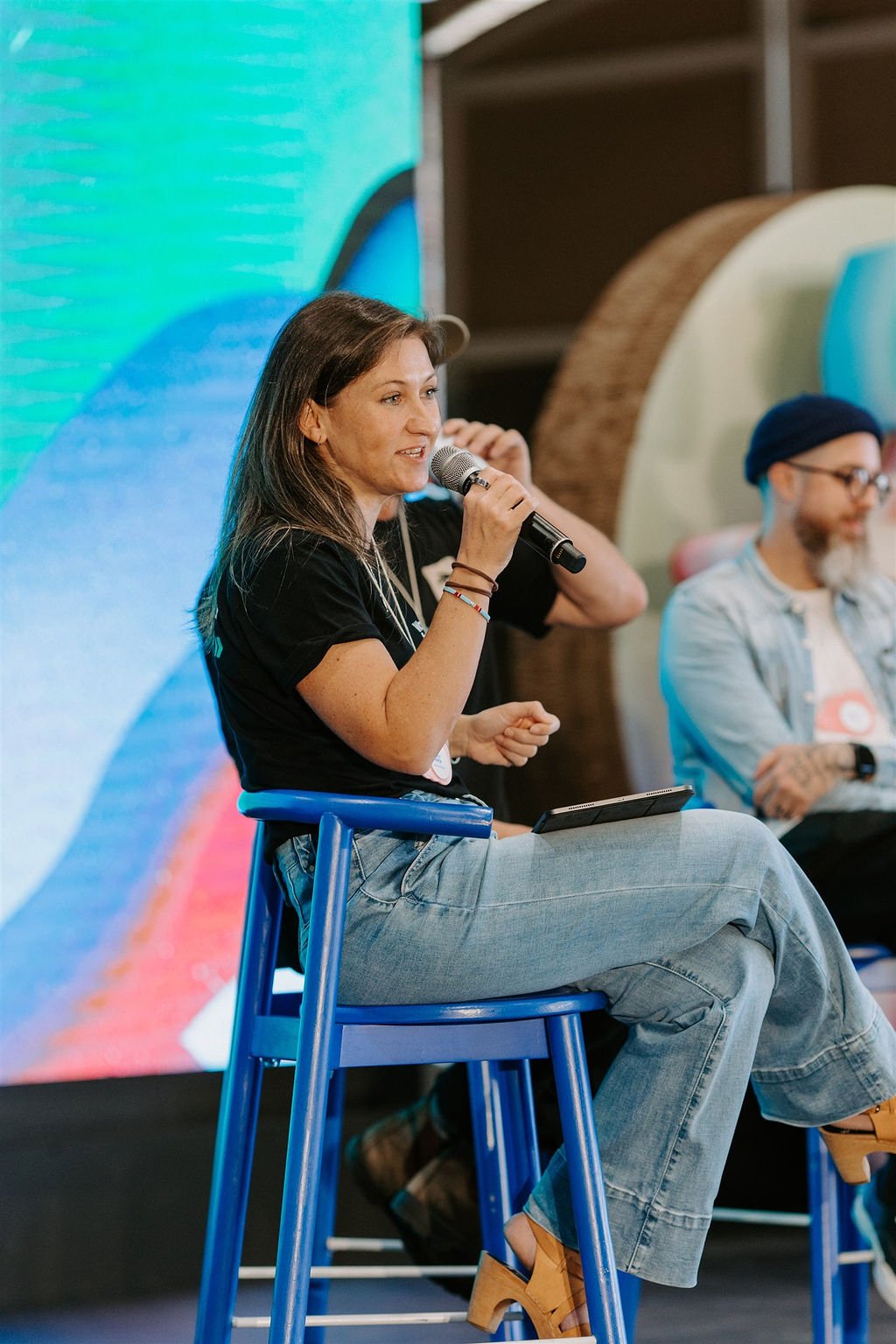
Lucy Piper at the Purpose Conference 2022. Photo by Elin Bandmann Photography. Image supplied by WorkforClimate.
By Daniel Simons
Article Summary
Lucy Piper and WorkforClimate are shifting the focus of climate activism from individual lifestyle changes to the massive, untapped potential of organised employee action within large corporations.
By applying social movement tactics to the workplace - focusing on energy, emissions, finance, and influence -employees can effectively push their companies to adopt bold, science-aligned climate policies.
From internal coalitions at global tech giants to local sustainability wins at social enterprises, WorkforClimate provides the blueprints and community support to help professionals transform their companies into powerful drivers of systemic change
Over 2,000 years ago, Archimedes taught us that if you have a lever big enough, and the right fulcrum to place it on, you can move the world.
For Lucy Piper, director of WorkforClimate, one of the most powerful lever-fulcrum combos is a group of passionate individuals inside a large corporation.
That’s why she’s on a mission to make every job a climate job. Years of solid research from The Climate Compass and the United Nations has shown us that the majority of people are concerned about climate change and want to take action.
Yet while the escalating climate crisis has spurred billions of people around the world to sling solar panels onto their roofs, upgrade to EVs, or open their wallets for their favourite environmental NGOs, most people are completely oblivious to the exponentially larger impact they could have.
And that is, if they turned that same care and energy toward the place where they spend the majority of their waking lives.
Founded in 2020 by Bryan Rollins, a former General Manager at Atlassian, and incubated by The Sunrise Project, WorkforClimate shows how organised employees can move multi-billion and even trillion-dollar companies to reduce their environmental impact at scale, shift national culture, and drive systems-level policy change.
That’s an enormously higher return on caring than individual action can deliver.
WorkforClimate community member and advisor Maren Costa helped build Amazon Employees for Climate Justice into one of the world’s most influential employee climate movements.
She inspired thousands of workers to sign open letters, file shareholder resolutions, and stage walkouts, helping pressure the trillion-dollar behemoth to launch The Climate Pledge and commit to purchasing 100,000 electric delivery vans.

Who Gives A Crap's solar panel installation. Image supplied by Who Gives A Crap.
Closer to home, WorkforClimate Academy graduate Bernie Wiley persuaded his bosses at the toilet paper social enterprise Who Gives A Crap to establish a dedicated sustainability team.
He then helped convince the company’s landlord to install more than 200 solar panels on their warehouse roof, arranged to spell out “We Give A Crap.”
A literal case of shouting from the rooftops, the installation attracted nationwide media coverage and spotlighted the fact that Australian properties are using less than 5% of their rooftop solar potential.
From accelerating the shift to renewable energy to challenging greenwashing and climate obstruction, WorkforClimate equips anyone hungry for change with the blueprints, case studies, and community to turn workplace influence into real climate impact.
Matters Journal sat down with Piper to explore employee organising, corporate activism, and why the workplace is such a powerful lever for anyone who wants to move the world.
Lucy Piper. Photo by Elin Bandmann Photography. Image supplied by WorkforClimate.
What is the core mission of WorkforClimate, and why is unlocking the dormant power of the everyday employee such a potentially transformative lever for tackling the climate crisis?
The primary mission of WorkforClimate is to harness the massive energy of everyday employees and to get them to work together within corporations to accelerate the transition to a clean energy future.
I personally believe that corporate behavior is critical to solving most of the major problems we experience in society today. If we want corporations to act differently, they need to make completely different decisions. But corporations do not make decisions. People make decisions.
Employees represent a massive, vital wedge of influence within any organisation. For example, they can create the essential political and social space for a CEO to advocate publicly for progressive climate policies, even when the broader political context is hostile or highly conservative.
The corporate level is also where you can really have an outsized impact. Often, people spend huge amounts of mental energy reducing their personal carbon footprints.
Doing something as an isolated individual feels good. You get that warm fuzzy feeling of taking positive action. But individual action offers almost zero systemic leverage.
WorkforClimate takes that raw personal motivation and redirects it. By using the corporation you work for as a lever for change, you can have hundreds, or even thousands of times the impact.
With the climate crisis escalating, most people want to take action, but many hesitate because they worry that they lack the knowledge or technical expertise to step up. What would you say to those who want to drive change within their company but feel they aren't 'qualified' enough?
My advice is that you absolutely do not need to be an expert in climate science or complex technical solutions to get started. I am neither of those things.
On the WorkforClimate website, we have a Blueprint for Climate Action that could get you up to speed in an hour.
All of the technological solutions we need already exist.
We know the science, we know exactly what needs to be done. The major hurdles stopping us from solving climate change right now are entirely based in corporate politics and human behavior.
So, if you are a professional who is solutions-focused, someone who can map pathways and strategically influence people, your skills are urgently needed..
We are asking people to use the exact skills and tactics already available to them in their daily corporate roles and apply them directly to critical climate outcomes.
This is vital work right now and we need everyone. Also, some people think that tackling climate change will be depressing or overwhelming, but it can be really joyous.
When you join this space, you are actively entering a vibrant global community of people building an emergent future, and that can be really rewarding.
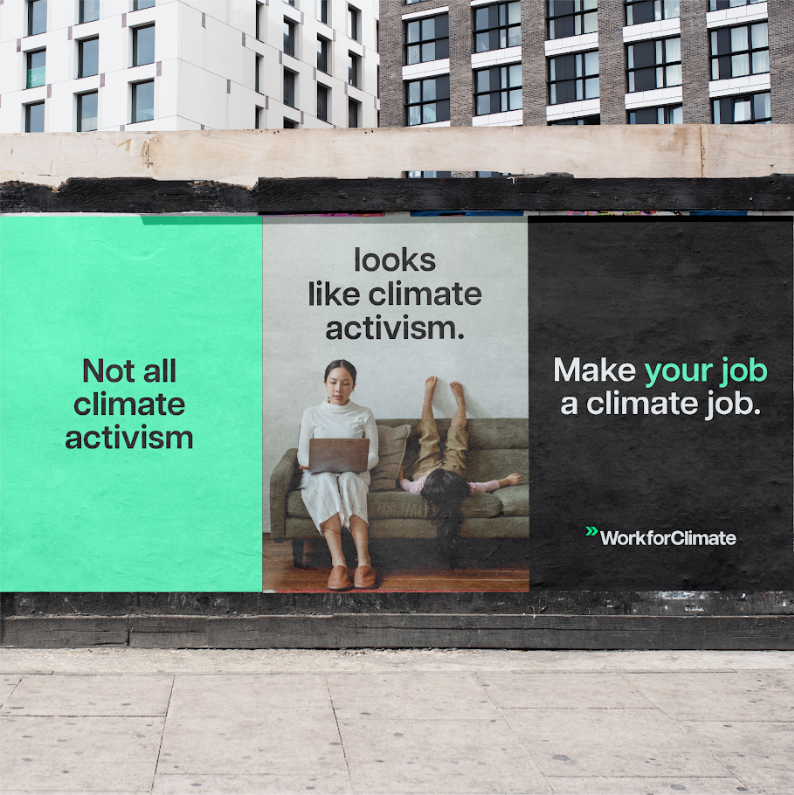
Image supplied by WorkforClimate.
WorkforClimate is focused on corporations as a leverage point, but your theory of change is heavily influenced by social movement theory. How does traditional social organising translate into a modern corporate environment?
Work for Climate was born directly out of the Sunrise Project, an organisation deeply rooted in progressive social movements. Our entire framework operates within a Venn diagram of three critical circles: climate science, systems thinking, and social movement theory.
History repeatedly shows that organised social movements are the only reliable vehicle for achieving massive positive change in societies.
The historic fight for civil rights, women's voting rights, and marriage equality all succeeded through highly organised social movements. The modern climate movement is no different.
We teach employees exactly how to organise.
It usually starts very simply. Find one or two close allies in your department who fundamentally agree with you about the state of the world.
Build an initial working group. Start with a quiet coffee catch up and pick a very easy initiative to win so you can build rapid internal momentum.
Then once you form a solid coalition, you can map out the specific obstacles stopping your company from changing and brainstorm tactical ways to overcome them collectively.
Once an employee finds their allies, what are the most effective levers they can pull? Do you provide a roadmap for corporate action?
Absolutely. We provide a highly structured, step-by-step blueprint, and we outline four main pillars of impact: energy, emissions, money, and influence.
The most obvious and straightforward first step is shifting the company to one hundred percent renewable energy. We have a dedicated playbook that walks employees through exactly how to achieve that quickly.
Step two focuses on direct emissions reduction. We actively guide teams to set a science-aligned, highly ambitious net zero target. We strictly avoid pie in the sky goals set for decades into the future and focus entirely on practical, immediate reductions.
Step three tackles what we call Scope X: the emissions your organisation enables through its influence, relationships and capital.
For knowledge-based businesses such as accounting firms, law practices and advertising agencies, that means asking difficult questions about who you work with. Are your clients accelerating the transition, or helping to entrench the problem?
It also means following the money. Where does your company bank? Where is the default staff superannuation fund invested? From cash reserves to retirement savings, every dollar should be aligned with a future free from fossil fuels and deforestation.
The final and highest step involves advocacy and direct lobbying. This requires pushing your company to leverage its massive public voice. We want companies influencing powerful industry associations to actively lobby governments for bold pro-climate policies.
It’s amazing to change a company's climate impact, but we also want to create change on a systems level.
So one thing we do, for example, is run ‘employee briefs’, which serve as a vehicle for turning critical political moments into tangible climate action on a national scale.
For instance, when the Australian government was set to announce its 2035 NDC (Nationally Determined Contribution) targets, we knew the fossil fuel lobby would push for a disastrously low target in the 50% to 60% range.
To counter that, we joined the "Business for 75" campaign, led by Future Group.
They did the heavy lifting of coalition building to get CEOs to sign an open letter demanding a 75% reduction.
To support this, we created an employee brief for our 5,000-plus members. We even drafted the email ourselves, allowing any employee to send the case for change directly to their CEO, effectively turning an abstract political moment into a direct tool for corporate advocacy.
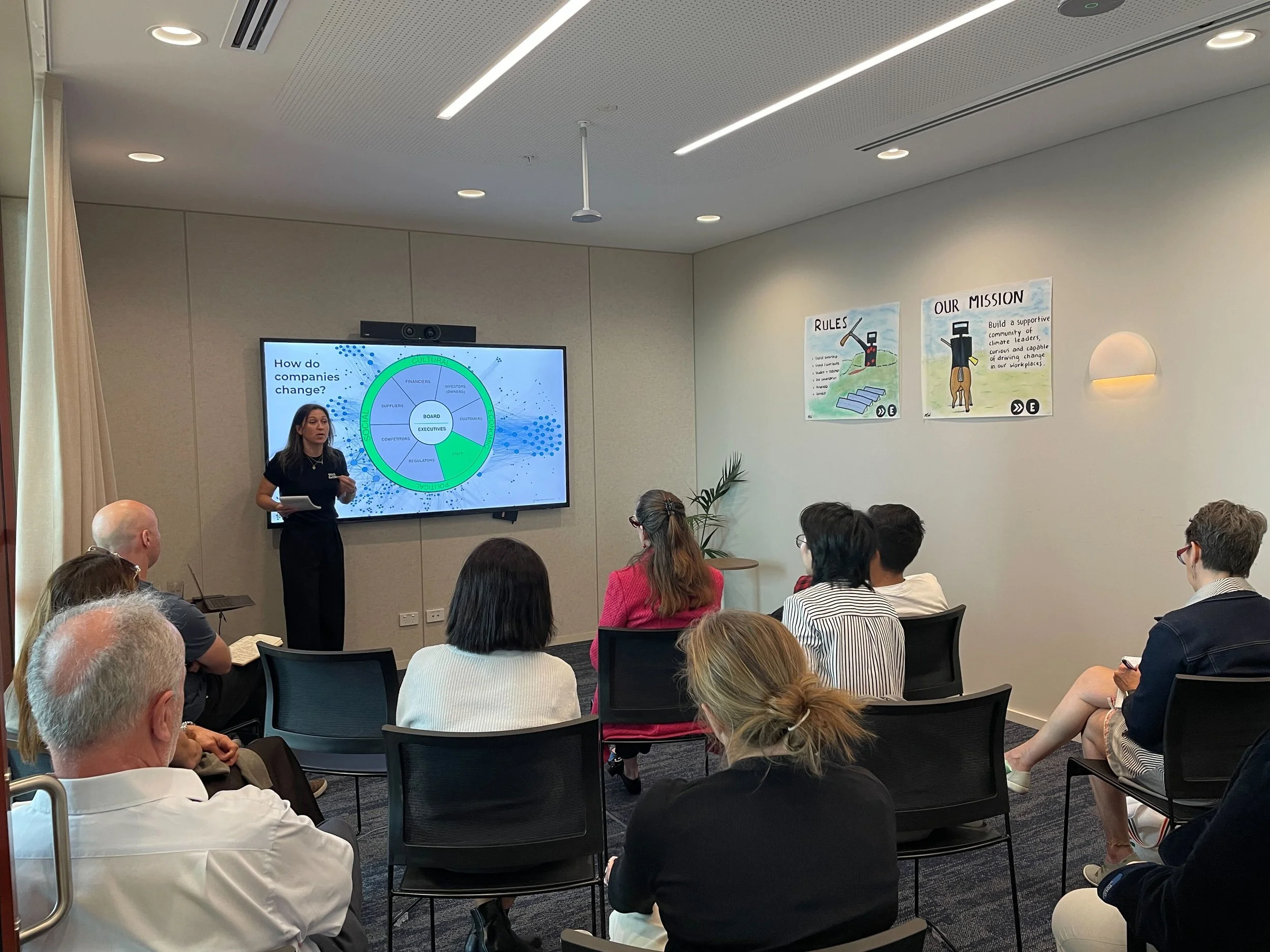
Image supplied by WorkforClimate.
WorkforClimate recently held an event exploring how to use artificial intelligence ethically and responsibly. How are you navigating the tension between AI’s massive resource demands and its promise as a tool to help solve the climate crisis?
It is an incredibly complex and heavy tension.
Right now, corporate leaders feel they must make a binary choice. They think they must choose between pursuing climate goals with absolute integrity or going all in on AI to maximise efficiency and profit.
I do not think establishing two completely opposing arguments is helpful for the future of humanity. We need to actively create distinct containers where corporations can establish ethical and moral boundaries around AI integration without abandoning their essential climate commitments.
I also think companies need to be aggressively workshopping the potential unintended consequences of AI right now.
On the environmental impact side, I really like the idea of the ‘Beyoncé’ model for all new data centers. BYONCE or, ‘bring your own new clean energy’. That could be a way to accelerate renewable energy buildout in Australia and also help us to develop our own sovereign AI infrastructure.
It's a very big topic and I’m keen to learn more from people who are thinking about AI in an ethical way and imagining what an ethical AI future might look like.
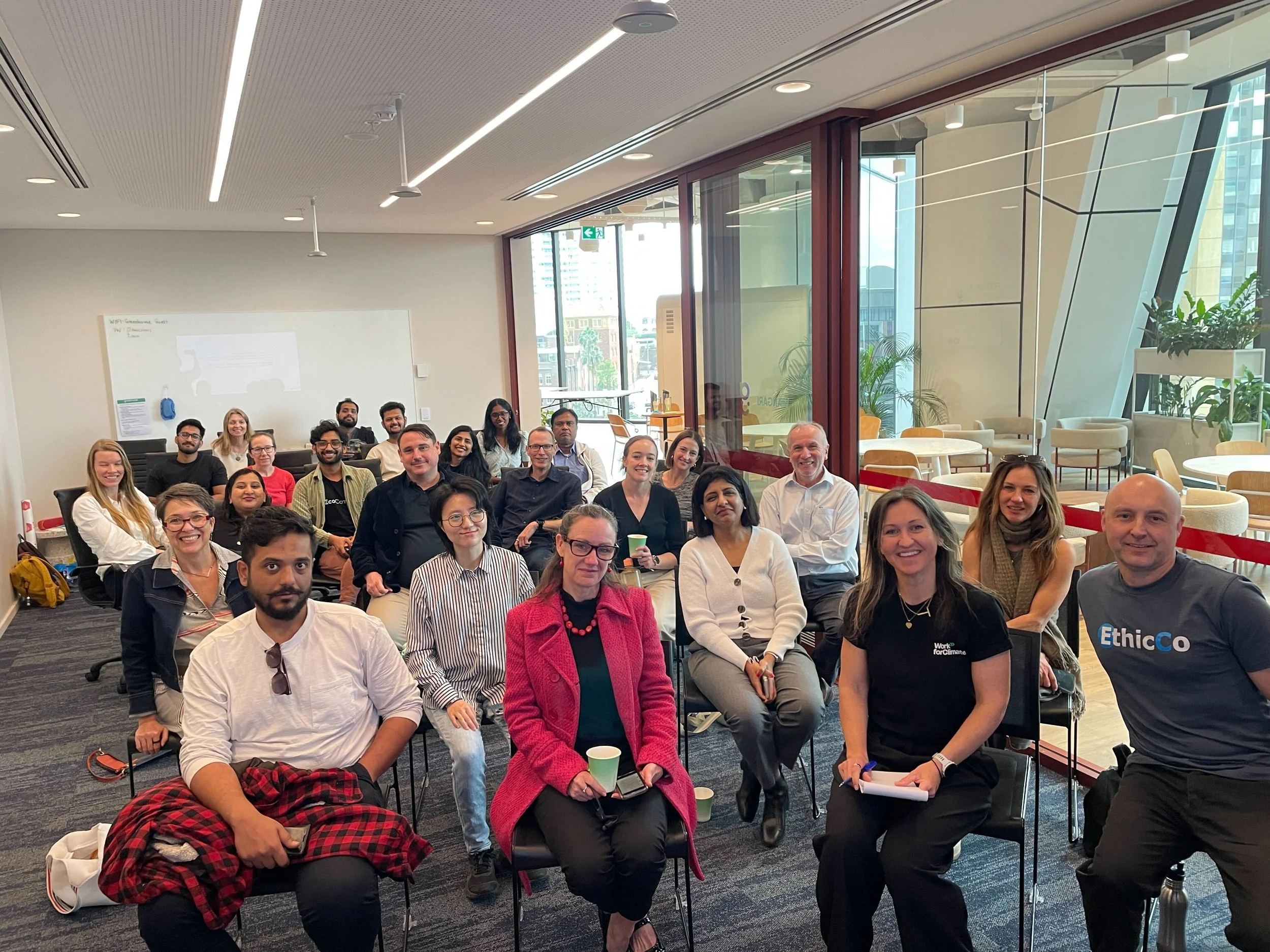
Image supplied by WorkforClimate.
What is next for WorkforClimate, and how can people join your community of changemakers?
At the moment we’re undergoing an organisational transformation which is challenging and also exciting.
We’re developing an AI coach that can access our entire knowledge base and guide employees through highly specific corporate scenarios, and we’re also expanding our work in Europe.
We ran our first European academy cohort towards the end of 2025 and we recently co-founded the Employee Climate Action Network, or ECAN to help unite all of the internal changemakers across Europe and the entire world.
It is a mutual aid coalition of groups who are trying to transform organisations from within, and we are very excited about the kind of campaigns that we can be running as a network to have a bigger impact than we can have on our own.
The best way to get involved is to head to our website and explore our resources and case studies, download our playbook, and sign up for one of our upcoming Academy cohorts.