
Beyond Mass Production: The Rise of Rare and Precious Edible Plants in Australia
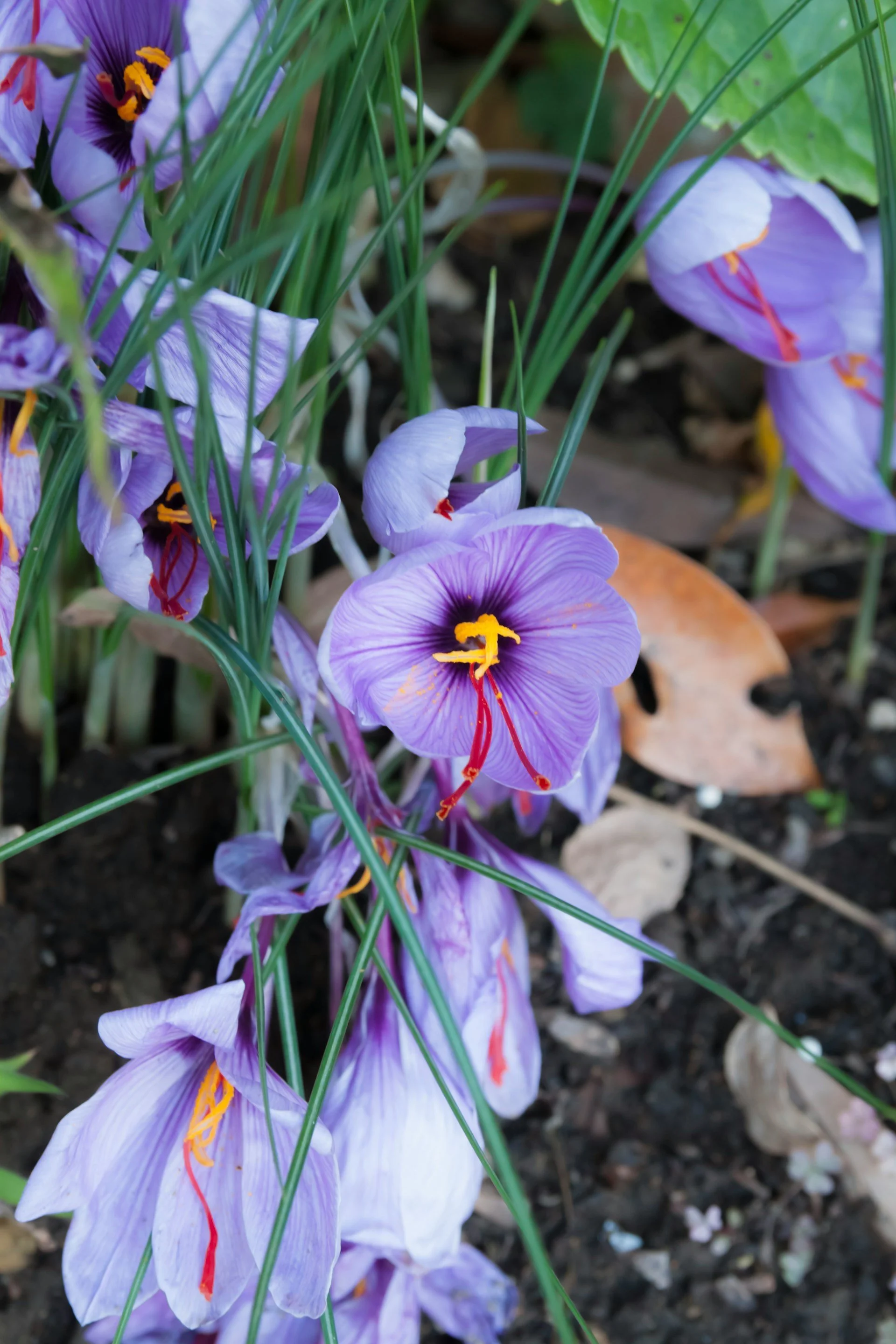
Saffron flowers. Photo by Lorenzo Lamonica on Unsplash
By Alexi Freeman
Article Summary
Australia's agriculture sector is increasingly embracing the cultivation of notoriously difficult, high-value crops like truffles, wasabi, and saffron, which challenge industrial farming's focus on speed and volume.
These temperamental plants demand significant patience, specialised conditions, and human care, making them precious for their unique characteristics rather than just their market price.
Beyond their commercial appeal, these rare crops offer a vital lesson in ecological diversity and suggest a more sustainable, human-centric alternative to modern, mass-produced food systems.
While many of us can barely keep a monstera alive in a sunny spot, growers across Australia are somehow coaxing life from some of the most notoriously difficult edible plants on Earth.
These are not your everyday garden variety crops. They are slow, temperamental, labour-intensive — and at times, astonishingly valuable.
Saffron retails for thousands of dollars a kilogram. Fresh truffles are sold by the gram, their price ebbing and flowing with season and supply. Even garlic, when fermented into its blackened, umami-rich form, commands a pretty penny.
But the real story isn’t about dollar value.
It’s about what happens when value emerges from time, difficulty, scarcity and human care — qualities that industrial agriculture has spent decades trying to minimise.
At a time of climate instability, biodiversity loss and industrialised food production, these stubborn crops invite alternative ways of thinking about value.
The rarest luxury may not be scarcity, but irreproducibility: species that cannot be rushed, shoehorned or reproduced with cookie-cutter precision.
Clive Blazey, co-founder of The Diggers Club, has spent more than four decades advocating for greater diversity in the seeds and plants available to Australian growers.
His observations about rare edible species point to the nuanced relationships between plants, people and place that make growing them possible.
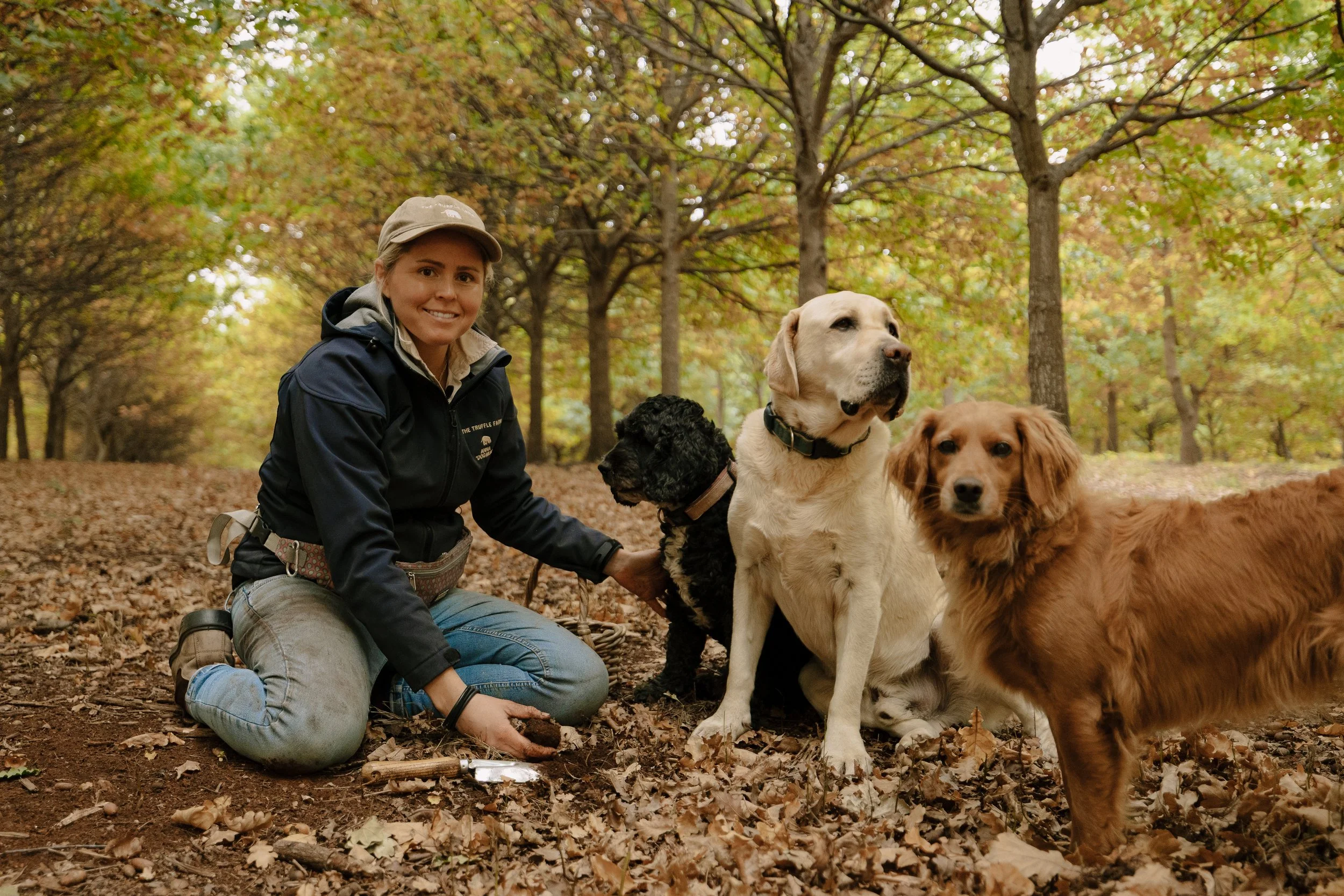
Anna Terry with 3 truffle-hunting dogs. Photo provided by The Truffle Farm, Tasmania.
Truffles: Buried Economies
Beneath the cool soils of Tasmania and regional Victoria, a hidden revolution has taken root.
Australia’s first black winter truffle (Tuber melanosporum) was harvested in Tasmania in 1999, following Tim Terry’s experiments with inoculated host trees in the 1990s.
His early research was met with scepticism, but “being told it couldn’t be done probably only made him more determined to prove that it could,” his daughter Anna Terry, owner of The Truffle Farm, told Matters Journal.
Today, truffières stretch across the country, but production remains a long game. Trees can take years to bear, yields are unpredictable, and harvest depends on the finely tuned noses of trained dogs.
The payoff is buried treasure: truffles are unearthed by hand at peak ripeness, their value dependent on timing, season and the whims of nature.
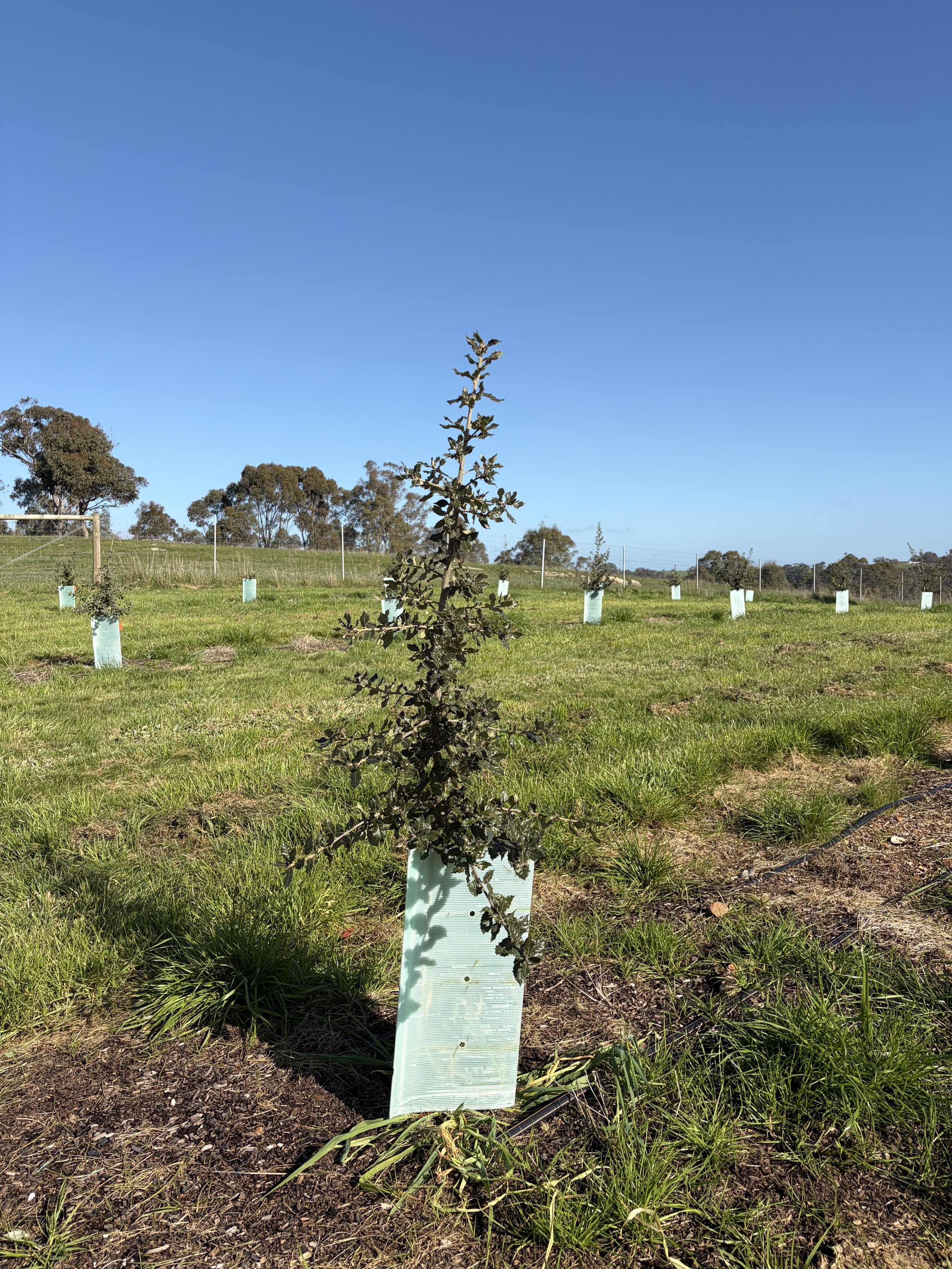
Young Oak tree at Mia Mia Truffles, Heathcote, Victoria. Image supplied by Mia Mia Truffles
Australia is now the world’s fourth-largest truffle producer, but the story is still being written. In August 2025, Lea Lewin and her family planted 469 oak trees at Mia Mia Truffles, their new truffière near Heathcote in central Victoria.
“When you’ve got a corporate desk job, you start thinking: what do I want to be doing for the next ten years? I thought I could be a part-time farmer,” Lewin explained to Matters.
Their first harvest may still be years away. For now, it’s an investment in land, family, patience — and the possibility of harvesting some black gold down the track.
Wasabi: Naughty by Nature
If truffles are elusive, wasabi is borderline mythological.
True wasabi (Eutrema japonicum) is notoriously difficult to grow, demanding cool, shaded conditions and plenty of patience. A single rhizome can take up to two years to reach harvest. Much of the wasabi served globally is actually dyed horseradish.
Australia has become one of the few places outside Japan where wasabi is cultivated, but the industry remains fragile. The closure of Shima Wasabi in 2025 — previously the only commercial-scale wasabi farm on these shores — has left the crop in an uncertain position.
Blazey recently encountered capers flourishing in the summer heat of Tuscany, and described wasabi as growing “in the opposite conditions, with cool running streams or waterlogged soils, so it’s rare to see in Australian gardens.”
Fresh wasabi is bright, aromatic, and fleeting, bearing little resemblance to its faux-sabi counterpart. Grating the rhizome releases compounds that produce its characteristic heat — a fiery intensity that burns brightly, then quickly fades.
Its fleeting quality is part of its appeal. There’s also something more enduring at play: a kind of evolutionary stubbornness, a refusal to be easily reduced to a green paste and packaged for corporate convenience.
In a food system increasingly designed around uniformity, a plant that refuses to play ball feels quietly radical.
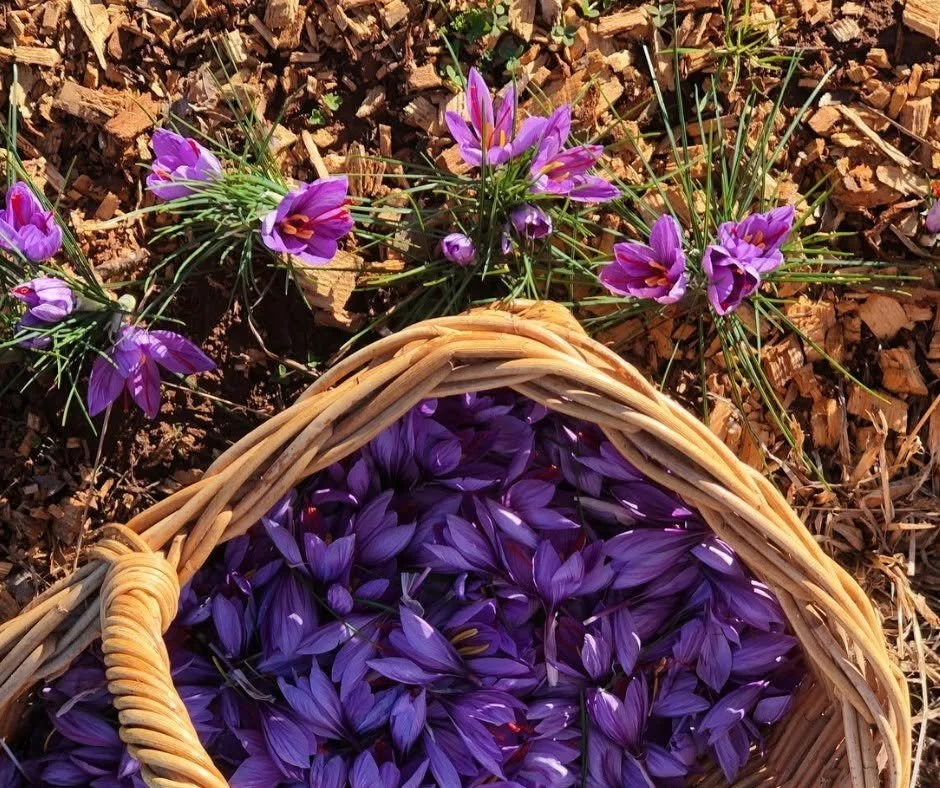
Harvest Flowers by Angela Argyle. Image supplied by Argyle Australian.
Saffron: Threads of Labour
Known as red gold, each strand of saffron begins as a lilac flower: Crocus sativus. Each produces three delicate crimson stigmas, and around 170,000 flowers are needed to produce a kilogram of the spice.
Saffron cultivation requires warm summers and cool winters, and growers have spent decades adapting this ancient crop to Australian conditions.
Corms were imported from the northern hemisphere in the 1990s, followed by years of cutting through red tape and experimentation before the first flower unfurled on Australian soil.
The result is a product as much about labour as it is about land.
Angela Argyle, director of Argyle Australian Saffron in Orange, NSW, told Matters: "Every flower has to be picked at sunrise, and stripped by hand within hours, or you lose it. There's no shortcut, no machine that can do what your fingers can.
"You wait eleven months for six to eight weeks of flowers, and even then only a fraction might come up each morning. Saffron teaches you patience whether you want it or not."
At a time when food is often stripped of its context, saffron insists on remaining seasonal, tactile and intensely human to process.
Its high price reflects not only scarcity but the labour of love embedded in every harvest, flower and thread.
Beyond Price
Truffles, wasabi and saffron reveal different kinds of value: the years required to grow truffle trees; the precise conditions demanded by wasabi; and the painstaking harvest behind every thread of saffron.
Hard-to-grow species offer a useful counterpoint to a food system built around speed and volume.
Modern agriculture excels at making crops uniform, predictable and available almost anywhere, any time.
But along with the convenience, we risk losing the diversity, flavour and ecological knowledge that come with plants adapted to particular places and conditions.
A crop that grows slowly, unpredictably or only in particular places isn’t necessarily inefficient. Sometimes, those limitations are precisely what make it precious.
Keeping a broad range of edible species and heirloom varieties in circulation helps preserve the genetic diversity of our food system, along with the knowledge needed to grow them.
Blazey recalled just how exuberant edible plants can be during his recent trip to Tuscany.
He described 30-metre-long caper plants thriving in the heat, with “hundreds of red stamens waving in the breeze, offsetting pure white petals to seduce the bees to nuzzle!
“This rare delicious flavouring is a precocious exhibitionist,” he explained to Matters.
It’s a lovely reminder that edible plants are not interchangeable commodities. They have individual personalities, requirements and relationships with the environments in which they grow.
Precious metals may be valuable because they're rare, but they're also inert. These edible species are valuable because they’re alive — rooted in soil, shaped by climate and season, and dependent on human care.
Perhaps their true value lies not in what they cost, but in what they enable: a food system that leaves space for diversity, patience, and place to grow.