
Australia's Green Conscience: Dr. Bob Brown on Apathy, Hope, and Collective Action
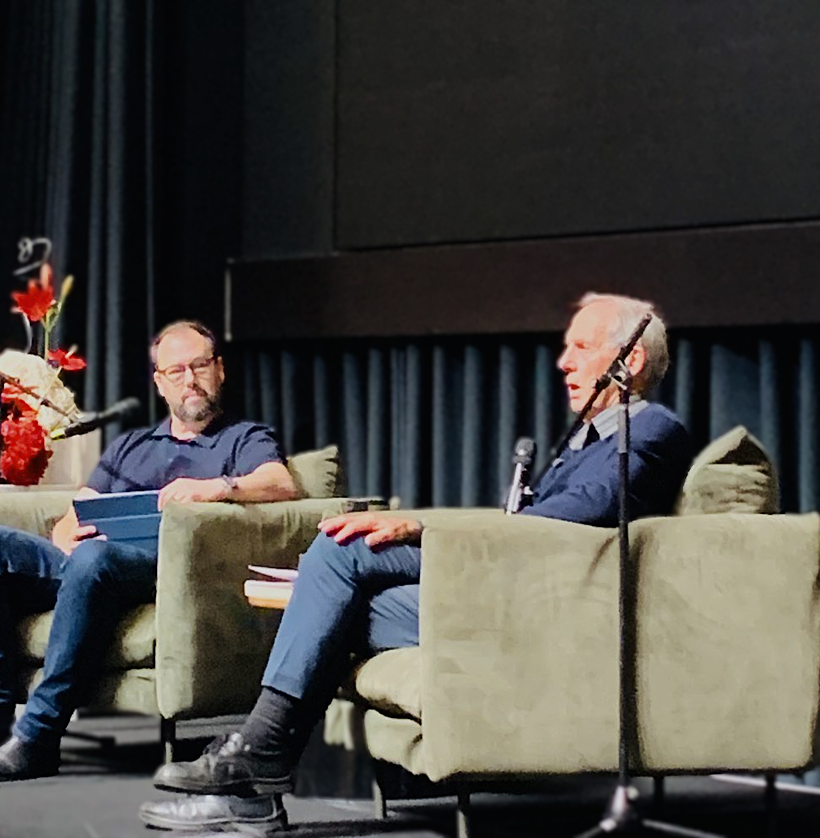
Bob Brown in conversation with Konrad Marshall at Melbourne Writers Festival, 2026. State Library of Victoria. Photo by Alexi Freeman.
By Alexi Freeman
Article Summary
- Drawing inspiration from historic "tree-huggers," Dr. Bob Brown has spent over half a century as an activist, prisoner, parliamentarian, and author, fighting for wilderness preservation in Australia.
Brown highlights Australia's apathy toward the ecological crisis, criticising the political timidity and corporate influence that continue to approve the destruction of critical habitats, notably in Tasmania's old-growth forests, which threatens species like the swift parrot.
Despite decades of intense environmental conflict, Brown maintains a message of collective hope and action, believing that the unifying purpose of safeguarding life on Earth offers the deepest meaning.
In 1730, the Maharaja of Jodhpur ordered the logging of the Khejri trees in India’s Thar Desert to build a new palace.
Amrita Devi and her daughters wrapped their arms around the trunks to protect them - and they were subsequently decapitated.
Another 359 Bishnoi villagers followed suit before the ruler relented, and the forest was saved.
Speaking at the Melbourne Writers Festival 2026, Dr Bob Brown retold Devi’s story to explain where tree-hugging comes from – not as an insult but as a lineage.
“I love being a tree-hugger,” Brown said, “it’s a term we should wear with pride.”
For more than half a century, Brown has followed in Devi’s footsteps, risking life and limb to place himself between wilderness and extraction — as an activist, prisoner, parliamentarian, and author.
In 1983, Brown was imprisoned for 19 days during protests against the proposed Franklin Dam in Tasmania. The campaign became a watershed moment in Australian environmental politics when the river was ultimately saved.
A year later, Brown entered the Tasmanian parliament. In 1996, he became the first Australian Greens senator elected to the federal parliament, serving until 2012, before focusing on advocacy through the Bob Brown Foundation.
Amid the blockade camps, the Senate chamber, courtroom battles, and forest protests lies Brown’s enduring question: What kind of country does Australia want to be?
Outside the State Library of Victoria, trams rattled along Swanston Street as Brown painted a picture of a nation sleepwalking toward ecological crisis.
“We are the wealthiest, freest country on the planet," Brown says.
“And apathy rules."
The line lands with the blunt force of a pub truth nobody wants to hear. Listening to Brown at 81, those chapters feel less like history than a single thread woven through a continuous campaign.
Roots of Defiance
Brown’s politics were shaped long before the Franklin River.
As a child, he described feeling out of step with the boys around him — less interested in shooting birds than observing them.
His mother taught him that wildflowers belonged in the bush rather than a vase.
Gungalidda Elder Wadjularbinna taught Brown a similar lesson whilst foraging for plums: “Don’t break the finger of the mother who feeds you.”
Different cultures. Same lesson.
His father, a police constable, imparted a healthy suspicion of hierarchy.
Brown recalled a bishop pulled over for speeding asking, “Do you know who I am?” Brown’s father replied, as dry as a climate-changed riverbed, “Well, Bishop, it’s lovely to see you; here’s your ticket.”
Brown’s upbringing shaped his belief that "You're not better, nor are you worse than anybody else. We’re all equal on this planet.”
Brown’s fierce egalitarian streak carried him into some of the most intense environmental conflicts in Australian history.
During the Franklin campaign, thousands mobilised to stop the damming of Tasmania’s wild southwest. Protesters chained themselves to machinery, floated blockade lines downriver, and 1400 protestors were arrested.
For many Australians, it marked the first time environmental protection became a political movement rather than a fringe concern.
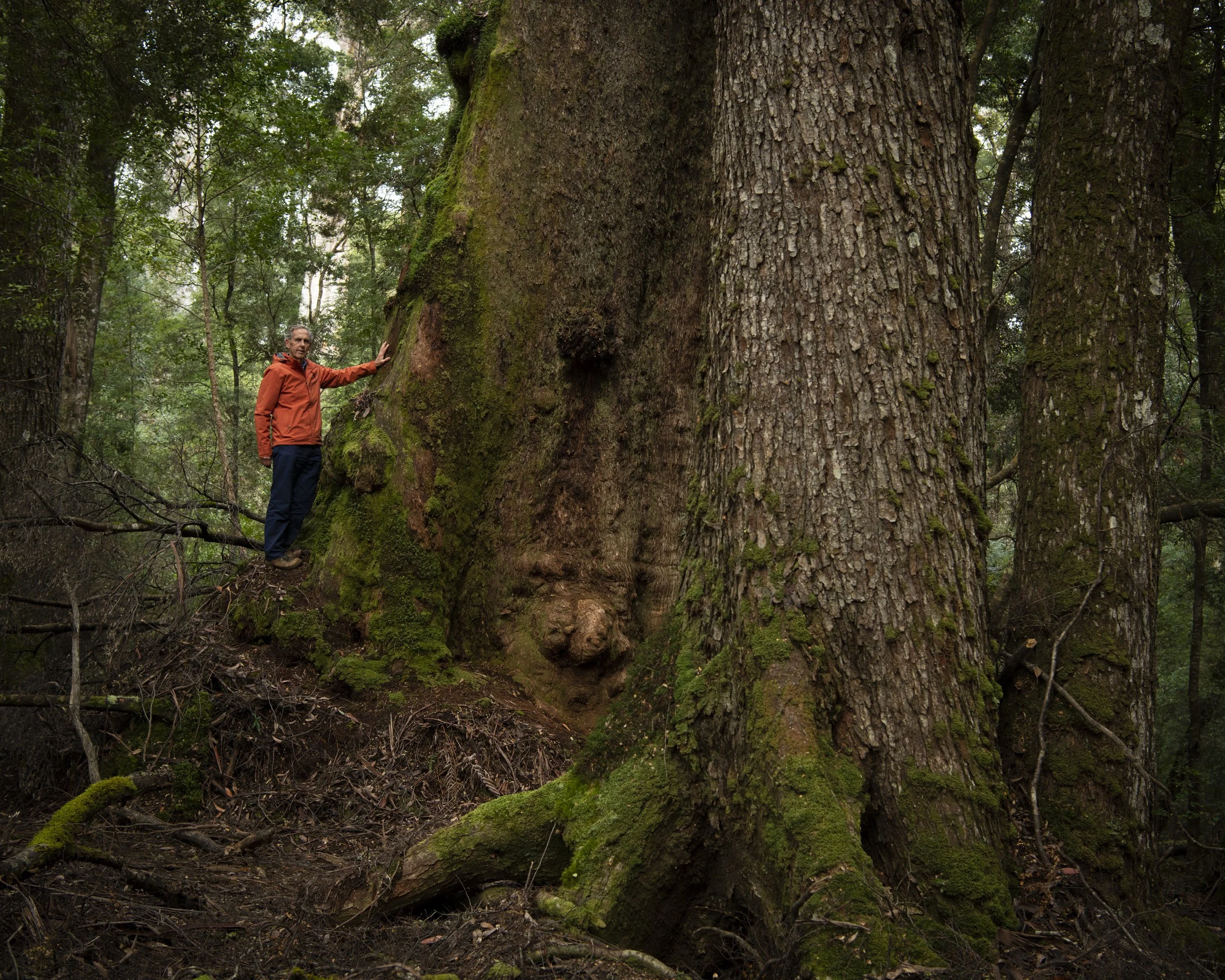
Bob Brown with an old-growth Myrtle in Tasmania's Takayna region (2022). Photo courtesy of the Bob Brown Foundation.
The Swift Parrot Test
Four decades later, Brown argues the stakes are even higher.
Tasmania’s old-growth forests remain under pressure, threatening the survival of numerous species.
Since colonisation, Australia has recorded more than 100 species extinctions — the fastest rate of mammal extinction in the world — with around 2000 species now listed as threatened, more than half of them endangered or critically endangered.
These include the swift parrot — a migratory bird that breeds in Tasmania’s old-growth forests — listed as endangered and threatened in all states where it resides.
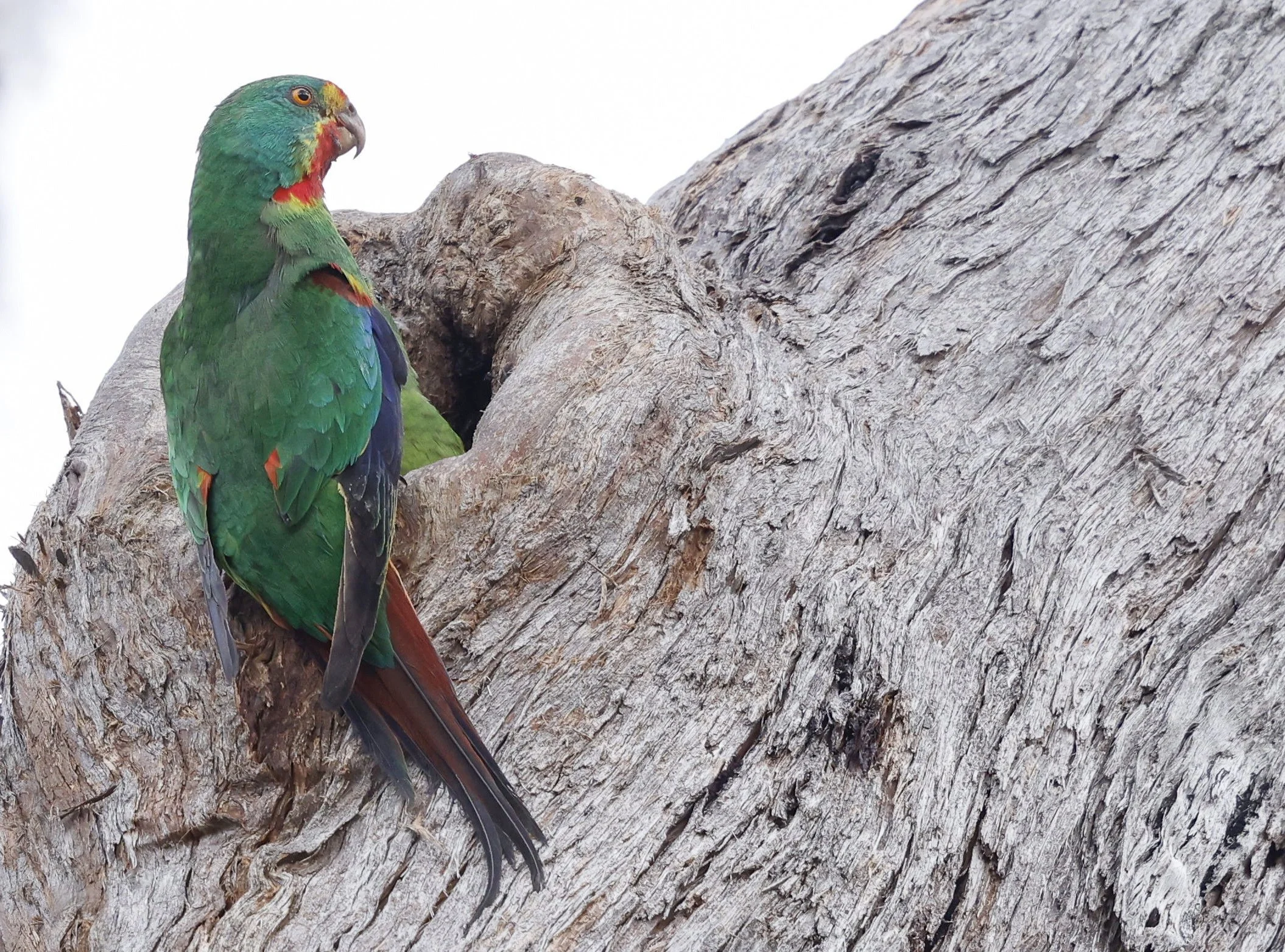
Swift Parrots nesting sites in native forests at Tasmania's Eastern Tiers (2021). Image courtesy of the Bob Brown Foundation.
“The swift parrot, which comes to Tasmania in summer to breed,” Brown said, "and they keep logging the trees from under it."
For Brown, the swift parrot has become shorthand for a deeper contradiction: governments speak the language of conservation while continuing to approve the destruction of critical habitat.
Recently, Brown was arrested while protesting logging linked to swift parrot habitat — an act he describes less as civil disobedience than civic obligation.
“The law says they must immediately stop logging if it’s reported that there are swift parrots there, but they didn't, and we got arrested instead.”
That tension resurfaces throughout the conversation. Brown spoke of corporate influence, political timidity, and the capture of democracy by extractive industries.
”If you want to get on in this world, don’t rob a bank; it’s dangerous, you might get caught… Be a big exploiter of the public commons, and rob future generations of their right to have a natural planet like we’ve got, and you’ll get government subsidies.”
There’s plenty in Brown’s worldview that sounds uncompromising; fossil fuel corporations are "marauders." Native forest logging is "ecological vandalism,” and corporate lobbying systems should be “dismantled entirely."
Yet what’s most surprising is not the anger but the steadiness.
Optimism as Resistance
At one point, Brown reflects on why he doesn’t appear more despairing about the state of the world.
“I was (depressed) during the Cold War for a decade or two. Medically depressed. And I realised it wasn’t getting me anywhere.”
Activism, Brown argues, cannot survive on despair alone.
“You have to be able to enjoy life if you’re going to be fully effective, and that means looking after yourself, as well as other people around you, and that means having fun… Taking a leaf out of the people of history who have stood up when they should have been knocked down.”
Brown writes longhand at Oura Oura in Tasmania’s Liffey Valley — his former home now owned by Bush Heritage Australia — without phone reception, often by kerosene lamp.
No SEO strategy. No feeding of the insatiable algorithm. Just the scratch of pen to page while the World Heritage Area outside continues its ancient cycles of birth, death, and rebirth.
When the conversation turns to jobs — the perennial pressure point in environmental politics — Brown refuses the usual binaries.
He recalled speaking with an anxious logger who told him, “I can’t read, and I can’t write… and I can’t do anything else.”
Brown argues workers should never be abandoned during ecological transition — nor used as shields for industries already in decline.
Nearly 90% of Australia’s timber producers already come from plantations rather than native forests. The real failure isn’t environmentalism but political imagination.
"The propaganda coming out of the already wealthy, the billionaire front, and the big corporations talks about jobs, and it’s a complete farce… A proper democratic society is there to look after people's jobs and make sure those who are dispossessed are looked after.”
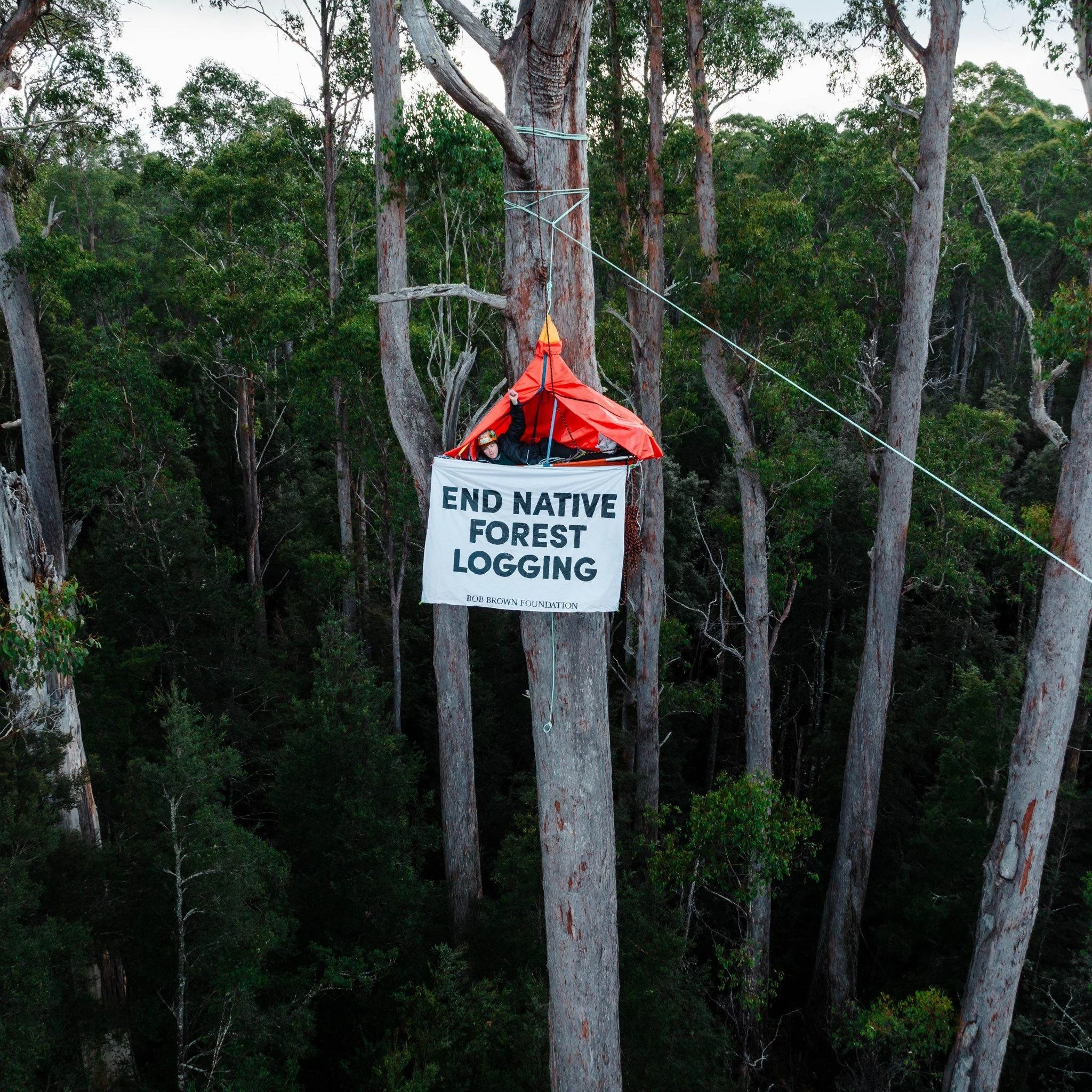
Bob Brown Foundation forest action in Tasmania’s Central Highlands (2025). Photo courtesy of the Bob Brown Foundation.
When asked about agriculture and Australia’s dependence on diesel, Brown responds not with doom but with anticipation.
“It will take a new imagination; it cannot come from the established parties simply tinkering at the edges.”
And then, unexpectedly, his tone softens.
He discussed the social upheavals of the 1950s and 60s — civil rights movements, anti-war protests, and the birth of modern environmentalism — and said he feels echoes of that energy now.
“Very exciting times; it’s coming.”
After decades spent watching governments rise and fall, old-growth forests bulldozed, and myriad species pushed toward extinction, Brown still believes our next chapter is unwritten.
Nearly 300 years after Amrita Devi wrapped her arms around a tree, climate victory can still be snatched from the bulldozer jaws of defeat.
Not easily. Not cleanly. But collectively.
Brown concludes Defiance with a message of hope:
"Our unifying purpose is to safeguard life on Earth and secure humanity’s future in the Universe. Far more than money, this simple and obvious pursuit offers meaning to our lives on this brilliant little planet.”
During Brown’s talk, Bob Brown Foundation activists in Tasmania’s Central Highlands stood in the snow, blocking logging roads.
Overhead, swift parrots searched the state's remaining old-growth forests for somewhere safe to nest.
“Something new is in the air,” Brown said.
- Listen to Brown’s fireside chat at Melbourne Writers’ Festival on Good Weekend Talks.