
How Indigenous Knowledge and Art Reshape Our Relationship with Water
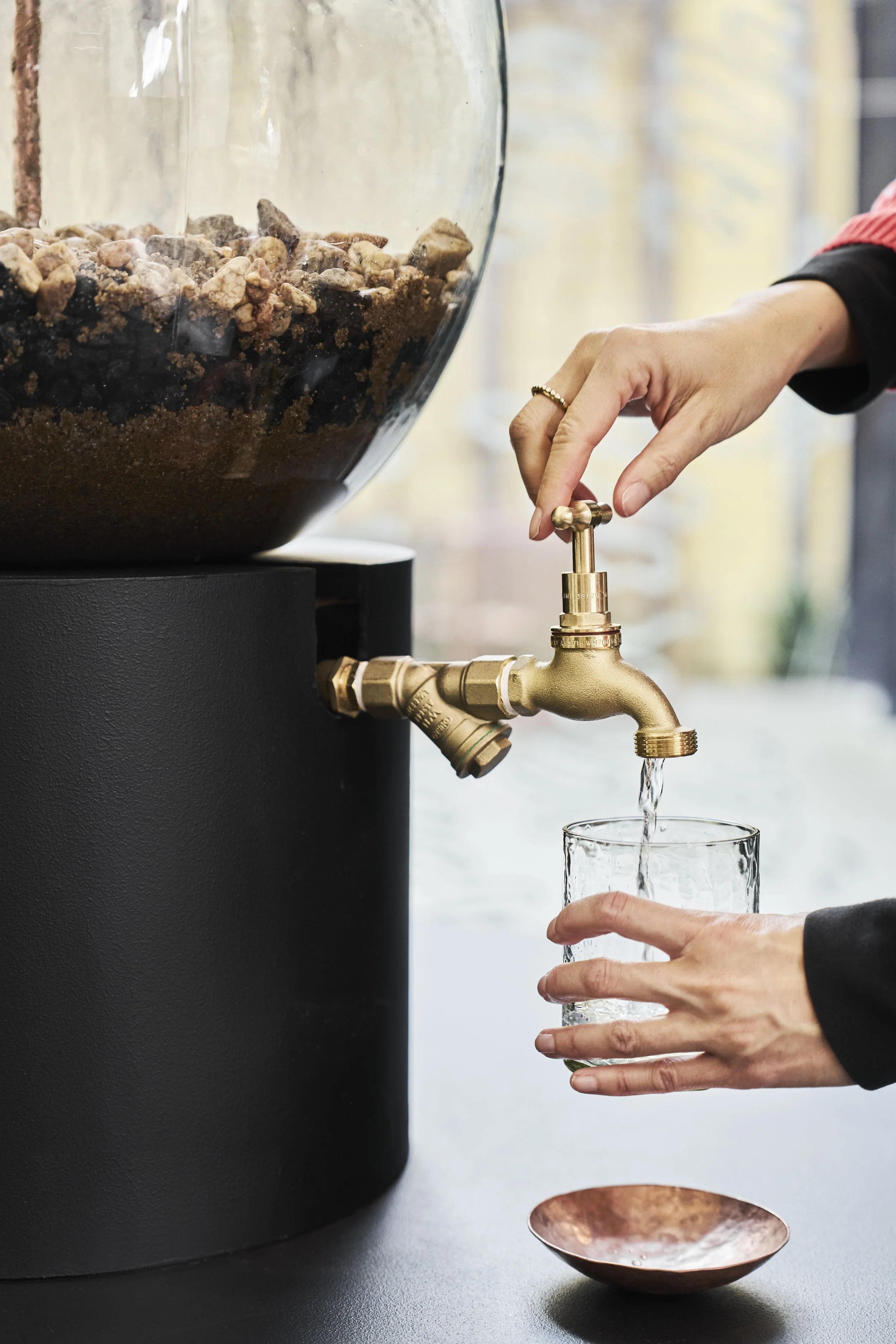
Close-up of the installation PIPES (gatjin) by Eugenia Lim. Image provided by La Trobe University.
By Alexi Freeman
Article Summary
Discover how the Actions for Water II exhibition in Bendigo explores water not as a mere commodity, but as living Country, ecology, and cultural memory.
Learn about the Dja Dja Wurrung People's inspiring $7 million restoration program returning life and native plants to Bendigo Creek.
Explore how contemporary artists and Indigenous knowledge are challenging colonial engineering to help us rethink our relationship with water.
We tend to notice water when it misbehaves.
A leaky tap, ruptured pipe, flooded storm drain, or burst fire hydrant erupting water skyward – water briefly escaping the systems we’ve built to contain it.
Most of the time, water dutifully appears when we need it, gurgles down the drain, and continues its largely hidden journey through pipes, rivers, wetlands, aquifers and oceans.
But just because it’s out of sight doesn't mean it should remain unseen. Water has never been as obedient as our infrastructure suggests.
In Melbourne, heavy rain reminds us that water carries memory: of landscapes altered, paths redirected and waterways buried beneath the city.
Elizabeth Street follows the city’s natural low point, once home to a creek forced underground as the colonial grid was built around it.
When the drainage system is overwhelmed, the watery ghost of the Elizabeth Street creek makes a dramatic cameo on the surface.
We channel, pipe, dam, drain, divert and send water underground, but we can’t erase its paths or its relationships with Country.
Houdini-like, it evaporates into thin air, seeps, pools, falls, flows and returns.
What might change if instead of trying to contain, harness and consume water, we better understood ourselves as part of its movement?
This question courses through Actions for Water II, an exhibition exploring how we live with water: not as a commodity, but as Country, ecology, cultural memory and a shared responsibility.

Under the Water, a miniature wax sculpture installation by Cambodian artist Sreymao Sao. Image provided by La Trobe University.
Water Remembers
Curated by Sharmila Wood and Amelia Wallin, the exhibition explores what happens when the systems we build collide with the waterways that were already there.
Bendigo used to be sustained by a network of seasonal waterways, but colonial infrastructure transformed, buried and restricted their paths.
Today, the creek moves through an urban landscape where its earlier form is difficult to see.
The Dja Dja Wurrung People (Djaara) are leading restoration work along Bendigo Creek, a waterway heavily impacted by gold-rush-era damage and subsequent development.
The $7 million Yaram Yaram Bayikina (Bendigo Creek Reawakening) program includes removing concrete-lined segments, replanting native vegetation and reconnecting people with the waterway, guided by Djaara-led planning.
At Wanyarra Dum (Frog Ponds), the work is revitalising habitat and connections to Country, while creating space for community gathering and reflection.
Djaara and Bangerang man Paul Phillips described Wanyarra Dum as “a hugely significant example of restoration work done by Dja Dja Wurrung People and DJAARA to bring back to life a part of Bunjil’s country that was suffocating under waste.”
The project has reintroduced “15,000 food and medicinal plants… to filter out any impurities from any water that flows through the ponds.”
Djaara have used these plants for “tens of thousands of years through cultural practices passed on through Bunjil.”
Wallin said learning from Djaara helped “crystallise the extent to which waterways and water systems in the region were disrupted through colonisation,” giving the Bendigo iteration a distinctly site-responsive dimension.
In a 2026 paper, (Un)regulated wetlandscapes – laang tageek baany in Boonwurrung Country, Nairm, the six co-authors (Ana Lara Heyns, Carolyn Briggs, Brian Martin, Maria de Lourdes Melo Zurita, Laura Harper and Catherine Murphy) describe wetlandscapes as interconnected wetlands and surrounding environments that resist colonial categories: “neither fully surface nor groundwater, neither fully natural nor human-made.”
The concept of wetlandscapes offers an alternative way of seeing Bendigo as a place where water, land, infrastructure, ecology and cultural knowledge intersect.
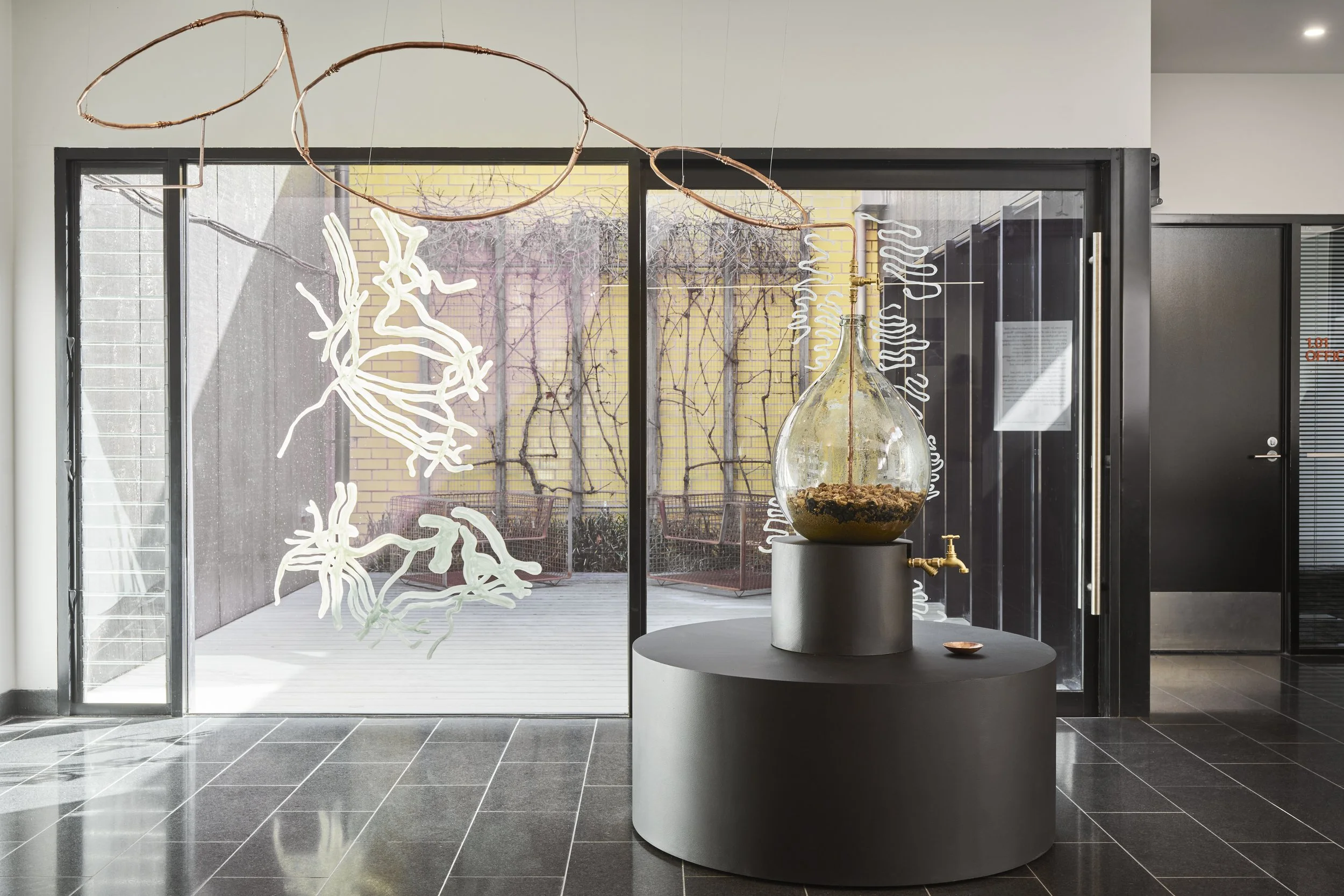
PIPES (gatjin) by Eugenia Lim, developed with plumber Maddi Mansfield and Djaara Traditional Owner Bec Phillips. Image provided by La Trobe University.
Water Connects
In PIPES (gatjin), a site-specific work by Eugenia Lim developed with plumber Maddi Mansfield and Djaara Traditional Owner Bec Phillips, copper pipes form three interlocking circles that reference Bendigo’s former chain of ponds.
Water moves through the installation and is filtered through materials gathered from Country before visitors can drink it.
For Lim, the work makes visible histories usually hidden inside the infrastructure around us. “You can read the history of colonial approaches to lands and waters in the way water is and has been engineered, piped, treated or denied to communities.”
Lim described PIPES (gatjin) as “a kind of humble marker of the relational process with Maddi and Bec,” formed by their conversations, Phillips’ guidance about Djaara Country and water sovereignty, and Mansfield’s fabrication skills.
“As clean water becomes scarcer and more politicised globally,” Lim added, “there's no gesture more important than providing a clean drink of water.”
In Australia, access to water isn’t evenly distributed, and historically, water management hasn’t been neutral. First Nations peoples’ longstanding ties to water predate the colonial systems that now govern its allocation.
Numerous currents run beneath the exhibition: who has access to water, who controls its flow and whose knowledge informs those decisions.
Mei Swan Lim’s Insect Opera gives voice to the small creatures and ecological processes of Baigup and Beeliar wetlands in Western Australia through field recordings layered with intuitive vocal performance.
Cambodian artist Khvay Samnang’s Untitled responds to the filling of Phnom Penh lakes with sand to reclaim land for luxury development.
Imani Jacqueline Brown’s What Remains at the Ends of the Earth? traces the impacts of fossil-fuel extraction through Louisiana’s wetlands.
Interrupt a waterway, and you alter the lives, histories and ecologies connected to it.
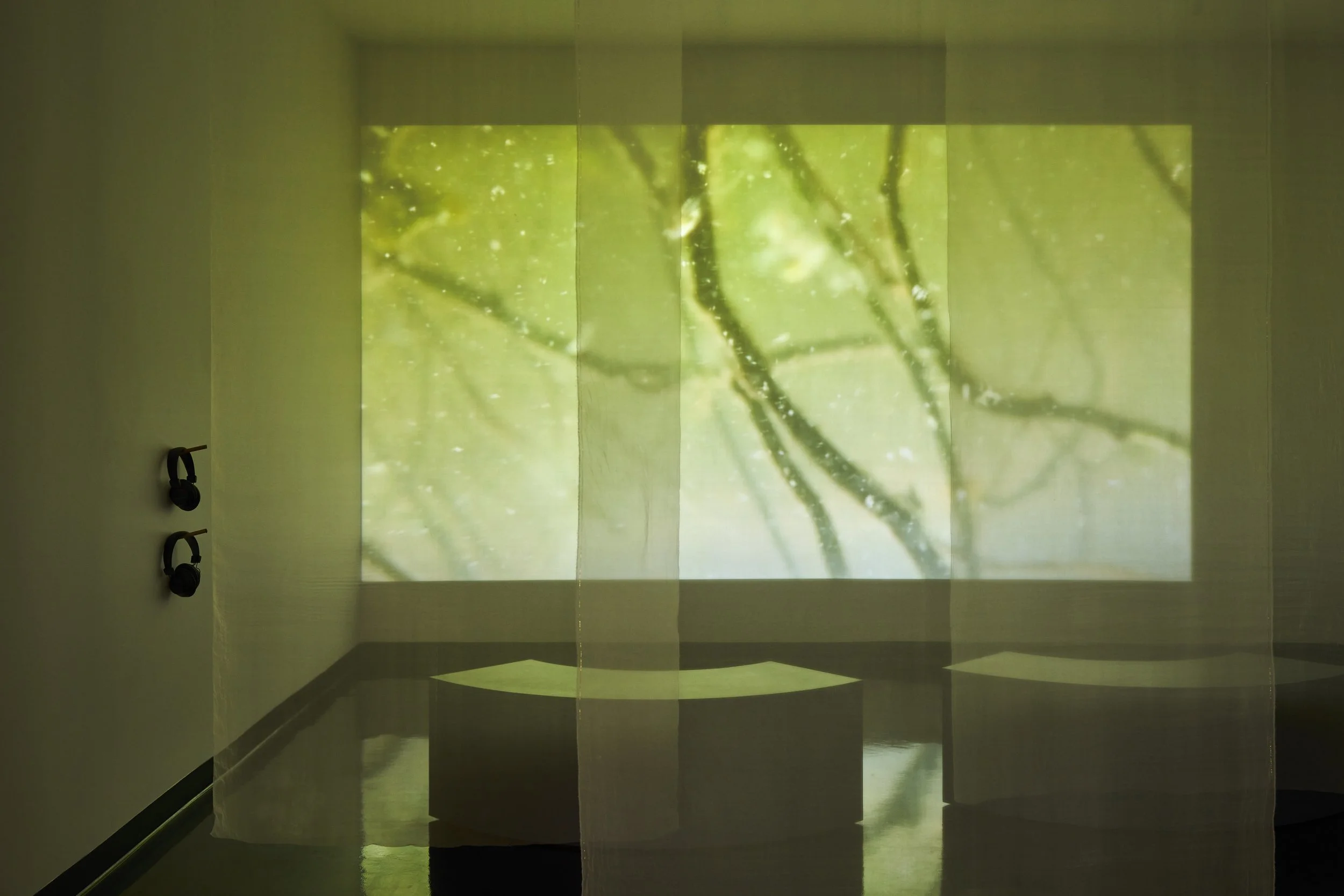
My Heart Floats in the Water by artist Tomoko Hayashi. Image provided by La Trobe University.
Water Flows
Actions for Water II is itself a kind of living water system, evolving in response to Country and the relationships formed along the way.
Wallin said Djaara consultation “introduced an important site-responsive dimension to the Bendigo iteration of Actions for Water, grounding the exhibition in local histories, Indigenous knowledge, and contemporary practices of environmental care.”
If water refuses the boundaries we draw around it, perhaps our institutions can be more porous too — enabling different knowledge systems to converge, like a cultural estuary.
Consider the myriad forms water takes: droplet, raindrop, puddle, mist, frost, hail, glass, stream, tributary, river, wetland, sea and tsunami.
We name each form and build systems around those distinctions, yet water is slippery, always moving between states.
The exhibition blurs the boundary between rain falling from the sky, water moving beneath a city street and water held in a wetland. The same substance carries traces of geology, memory, industry and life.
Perhaps this is what art can do: not solve an ecological crisis, but change how we experience it.
Art cannot restore a creek, but it can alter what we notice, shift what we care about, reveal overlooked knowledge and make a buried waterway imaginable again.
Wallin concluded: “I hope the exhibition fosters a deeper sense of connection with place, as well as a sense of responsibility and reciprocity, helping visitors to see themselves as part of a broader relationship with water rather than separate from it.”
In Bendigo, these questions aren’t abstract.
They’re present in a creek being restored, ponds being reawakened and an exhibition that ebbs and flows in response to Country.
Water has always been moving.
The question is whether we are prepared to move with it.