
Sir David Attenborough: A Lifetime of Service to Mother Nature
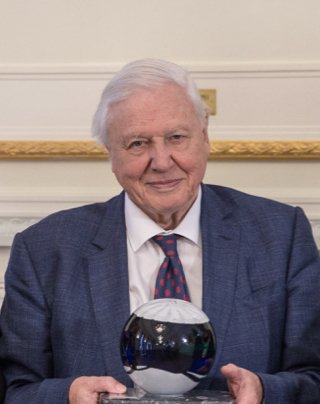
Sir David Attenborough receives the "Sustainability Award" 2018 at the Norwegian Club in London. Image by BergenChamber - Own work, CC BY-SA 4.0
By Alexi Freeman
Article Summary
As Sir David Attenborough approaches his 100th birthday, his decades-long broadcasting career has made him one of the most trusted voices in shaping how billions understand and emotionally connect with the natural world.
Through curiosity-driven storytelling rather than activism, his documentaries have educated generations, influenced scientists and campaigners, and evolved alongside major scientific and cultural shifts in environmental awareness.
His enduring legacy lies in reframing nature as interconnected, fragile, and close to home, fostering empathy that inspires collective responsibility for planetary care.
Amongst 400 billion stars in our galaxy, few shine as brightly as Sir David Attenborough. As he celebrates his 100th orbit around the sun on May 8, 2026, it’s worth reflecting on his role in shaping how we understand and care for the natural world.
When Attenborough began broadcasting in 1952, the small screen was still finding its audience. Today, he is one of the most recognisable and trusted voices on our planet.
Countless metrics attempt to gauge Attenborough’s influence, though none fully capture it. Over a billion unique viewers have watched Planet Earth, making it one of the most widely viewed franchises in history.
He has filmed on seven continents, in 80 countries, and in hundreds of locations — from 4,000 metres above sea level on Borneo’s Mount Kinabalu to 300 metres below sea level at the Great Barrier Reef.
But numbers only tell part of his story.
Attenborough’s true legacy is his ability to translate the wildest places on Earth, bringing once inaccessible wildernesses into the intimacy of our homes, learning environments and collective imagination.
In so doing, Attenborough has shifted how generations of people feel about Nature, reframing humanity’s place within an interconnected planetary network.
A Lens to Nature
Attenborough’s documentaries are a formative education in wonder. He has never spoken down to his audience or pressured us to become Nature lovers; instead, he’s invited us to slow down, observe patterns and behaviours, and reflect on the complexity of natural systems — and our place within them.
His influence extends beyond the confines of edutainment. Countless naturalists, scientists, filmmakers, conservationists, and educators trace their trajectories to watching his programs as children, with his infectious curiosity narrating an ancient world that feels increasingly alive with consequence.
Greta Thunberg has credited Attenborough’s documentaries as formative in shaping her climate activism, underscoring how his influence has extended beyond public sentiment to help reorient the moral compass of a new generation.
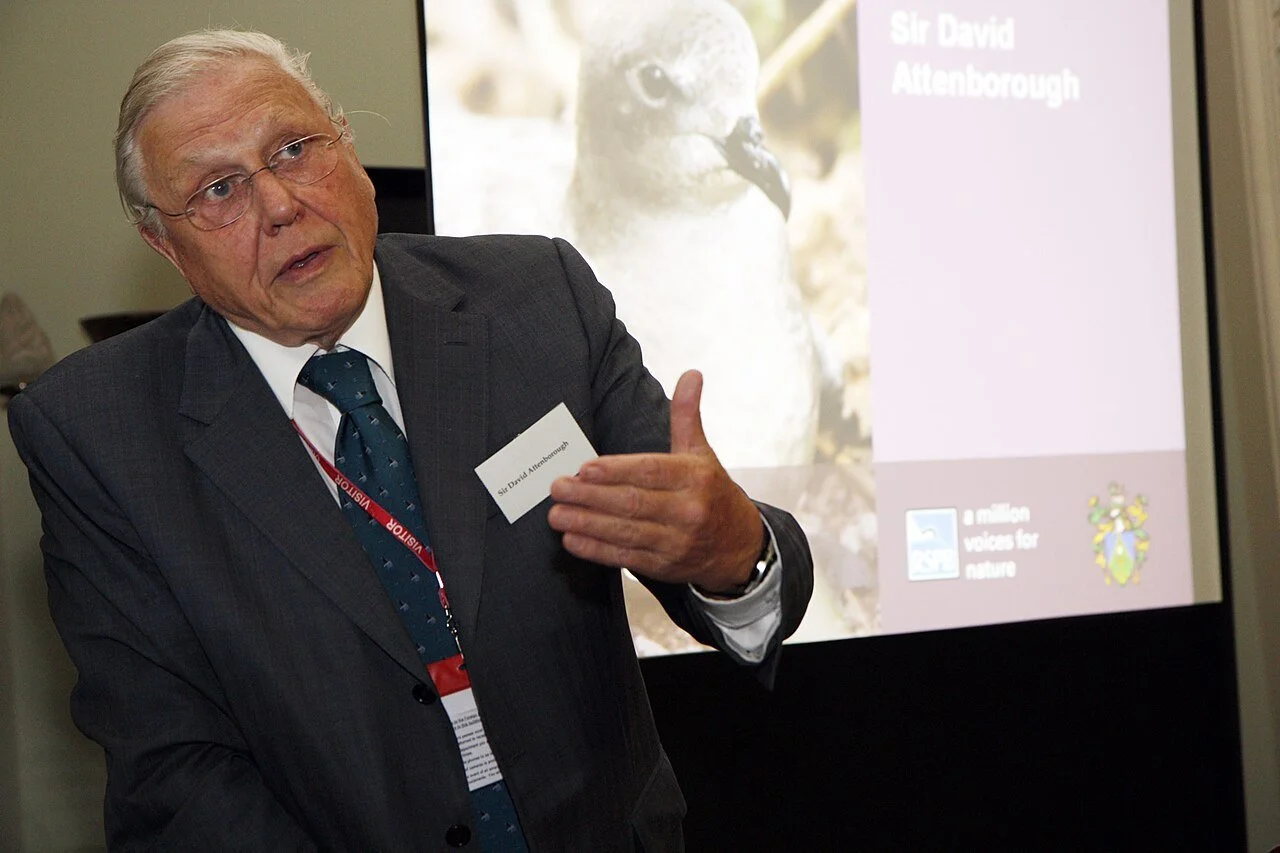
Sir David Attenborough speaking at an event held at the FCO in support of Henderson Island World Heritage Site, 6 July 2010. Image by Foreign and Commonwealth Office, OGL v1.0OGL v1.0.
A Century of Curiosity
This lineage of influence poses two overlapping questions: Who and what shaped the Attenborough we see today?
When Attenborough began his television career at the BBC, the modern environmental movement did not yet exist, ecology was the domain of scientists, and climate change wasn’t a dinner table topic.
Attenborough’s early fascination with the natural world was rooted less in activism than in curiosity — in observation, listening, and the adventure of exploring a planet teeming with so many yet-to-be-documented life forms.
As Attenborough’s understanding of natural systems matured, his broadcasting unfolded against landmark revelations — scientific, cultural and technological — that reshaped humanity’s understanding of Nature.
Such shifts include the publication of Rachel Carson’s Silent Spring (1962), groundbreaking research exposing the devastating environmental consequences of widespread pesticide use.
In 1963, Jane Goodall illuminated the complexity of primate behavioural patterns in National Geographic, revealing deeply social, emotionally rich chimpanzee communities.
The Earthrise photograph taken during the 1968 NASA Apollo 8 mission, depicts a small blue dot floating above the Moon’s horizon in a vast Universe. The image reframed Earth from an endless resource for extraction to a singular, fragile ecosystem in need of our protection.
Astrophysicists first reported a dramatic thinning in Earth’s ozone layer over Antarctica in 1985, a phenomenon that stunned researchers and the public alike. This prompted the 1987 Montreal Protocol — an international treaty that led to the phasing out of ozone-depleting chemicals.
Svante Arrhenius’s greenhouse calculations (dating back to the early 20th century) culminated in scientific consensus by the 2000s that human activities are the dominant cause of global warming.
It’s difficult to imagine Attenborough’s later work — with its focus on interdependence, environmental limits, and stewardship — without this dawning awareness that there is no Earth-like reserve waiting in the wings.
Part scientific discovery, part global reckoning, these watershed moments contextualise much of the environmental urgency that Attenborough has worked tirelessly to convey. Across decades of storytelling, his oeuvre bridges the evolution of scientific understanding with how humanity feels.

Urban Wilds
Significantly, Attenborough has never confined Nature to the remote or the exotic.
Australia has featured prominently in Attenborough’s work — not only for its megafauna and globally recognised wilderness — but also for the biodiversity of suburbia.
Across 37 visits, Attenborough has documented everything from the otherworldliness of the Great Barrier Reef to the aural weirdness of the lyrebird, whose mating calls reinterpret chainsaws and camera shutters into a strange cacophony of bush-born remixes.
Attenborough has also cast his attention to the elusive tawny frogmouth — an Australian nocturnal bird often mistaken for an owl and a master of camouflage.
By documenting frogmouths in Melbourne backyards, Attenborough reminds us that biodiversity doesn’t only live in national parks or far-flung destinations. Sometimes wild creatures are perched quietly above the Hills Hoist, blinking their wise yellow eyes at us as night falls.
Nature as a neighbour, rather than novelty, feels especially resonant in Melbourne, where native wildlife weaves its way along the extensive Birrarung/Yarra River nature corridor, adapting to habitats nestled between bricks and concrete.
Attenborough shows us that observing and listening to the wildness around us — often right outside our door — may be the first steps toward planetary care.
Eco-consciousness
Awareness of Earth’s vulnerabilities — including ozone depletion, biodiversity loss, and global warming — has evolved alongside Attenborough’s career, transitioning from observation to an understanding of what threatens natural systems, why that matters, and how we can collectively repair them.
This evolution — from curiosity to awareness to advocacy — mirrors a broader shift in environmental consciousness over the last century.
As Attenborough reminded us at COP26, “We are, after all, the greatest problem-solvers to have ever existed on Earth.”
After a century of life, Attenborough’s greatest legacy may not be what he has revealed, but the empathy he has cultivated for the living world we call home — and the planetary care that empathy inspires.