
The Rise of Ecovillages: A New Model for Community and Climate Action

Ecovillage Lifestyle Experience Week at Gaia Ashram in Thailand.
By Alexi Freeman
Article Summary
Ecovillages are thriving global communities offering sustainable, community-based alternatives to urban living, prioritising shared land, environmental care, and social connection over individual wealth.
Australian examples like Maleny, Narara, and Tasman Ecovillages demonstrate models of cooperative, low-impact living that balance modern convenience with ecological responsibility and social wellbeing.
Rooted in global movements like Findhorn, ecovillages highlight how collaboration, regeneration, and inclusivity can help reimagine housing, climate resilience, and human connection in a changing world.
They say it takes a village. And with the liveability of cities declining due to the housing crisis and climate change, it will likely take a few.
Human populations living in urban areas are estimated to surge to 60% by 2030, prompting many city slickers to opt out of the concrete jungle to join a growing global phenomenon known as an ecovillage.
An ecovillage is an intentional, traditional, or urban community that is consciously designed through locally owned participatory processes in all four dimensions of sustainability (social, culture, ecology, and economy) to regenerate social and natural environments.
Since Findhorn — the first modern-day ecovillage — was founded in Scotland in the 1960s on eco- and spiritual values, over 10,000 villages have sprouted up around the world, home to more than 500,000 people seeking greener and more harmonious ways of inhabiting Earth.
Advantages include their legal framework, which facilitates the creation of shared wealth, supporting happier, healthier, and more sustainable relationships.
Crucially, collaborative protection of land extends beyond the biological lifetime of residents.
Often situated in proximity to major public infrastructure, residents are free to enjoy the benefits of mod-cons while living more harmoniously with the land and each other.
Global examples include in Portugal where ‘Tamera’ centres on peaceful co-existence between humans, animals, and the natural world.
Germany’s ‘Sieben Linden’ has slashed its CO2 emissions to a fraction of the national average, and Thailand’s ‘Lifechanyuan’ experiments with a model free from marriage, ownership, or hierarchy, testing whether true freedom from the shackles of the neo-liberal status quo requires liberation from societal norms.
Australia, too, has some wonderful examples of eco villages.
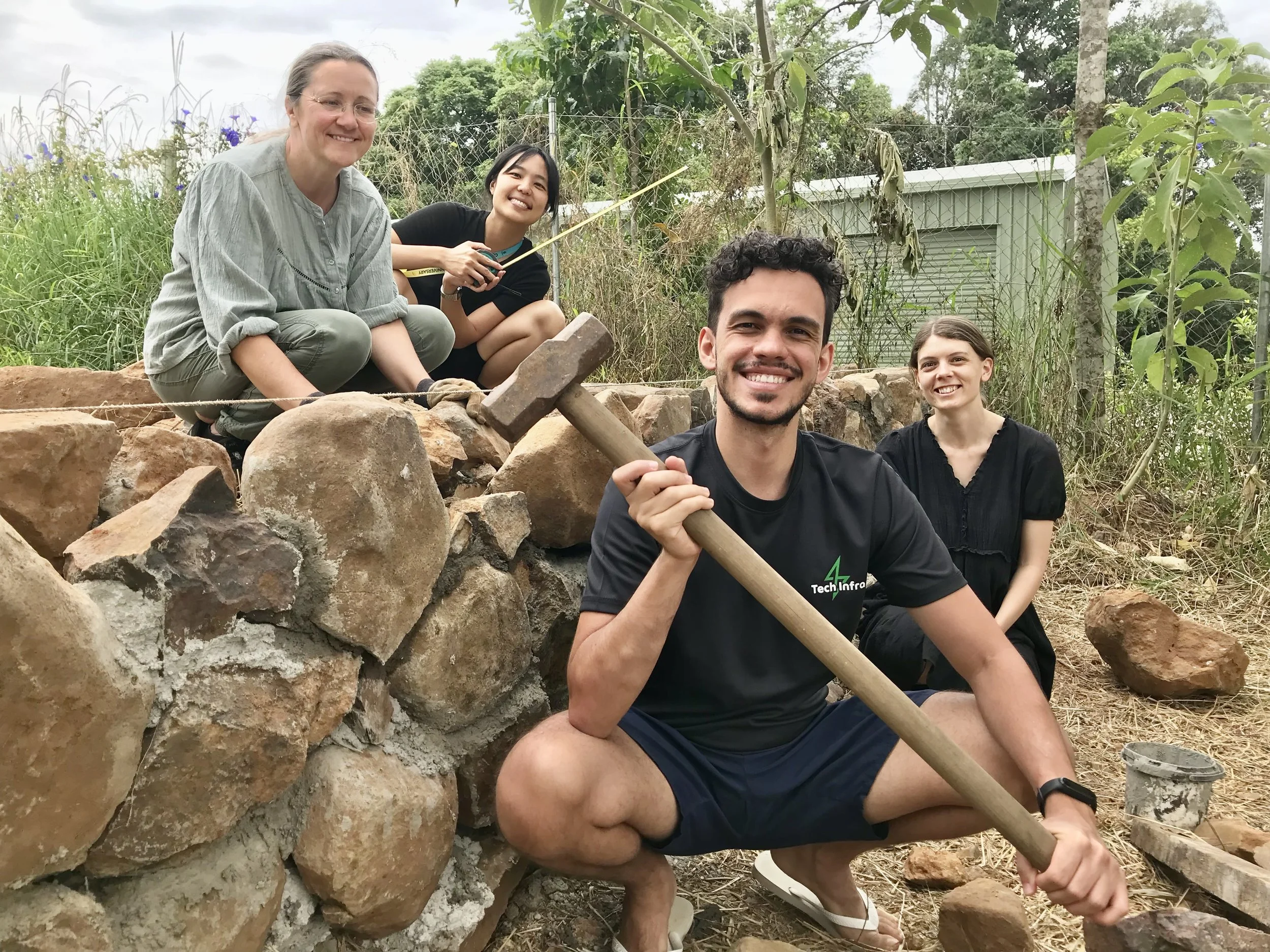
Travelers on Maleny’s week-long work program building their first stone retaining wall. Image courtesy of Maleny Ecovillage.
Maleny
Co-founded in 2019 by resident Andrew McLean, ambassador of Global Ecovillage Network (GEN), Maleny Eco Village holds shared land in perpetuity for its community, regenerates and preserves nature, and offers affordable housing.
Partially situated in a rainforest in south-east Queensland, with a creek inhabited by platypuses, a spring-fed dam, and avocados growing like weeds, Maleny smashes the myth that avo on toast is a roadblock to home ownership.
McLean said, “This is the life I knew I wanted when I was bored in the suburbs. The great Australian Dream is no longer about owning a home; it’s owning a house and selling it for a squillion dollars. There is no soul in that.”
A passionate advocate for the wonders of the ecovillage model, McLean added an impressive stat: “Our residents have a carbon footprint of 6% of the average Australian.”
He also debunked a misconception that ecovillages are exclusively home to off-grid, biodynamic, plant-based conspiracy theorists intent on dismantling the capitalist financial system and its underlying social structures.
Some Maleny residents have regular professional jobs — online or off-site — but reside in an ecovillage due to their commitment to caring for land and community.
“We’ve designed our society for isolation, and now Australians have an overdeveloped sense of privacy and need for space.
“The fact is that we need each other — we need community. Loneliness will be the next epidemic. Ecovillages and collaborative housing have a real place to meet this need.”
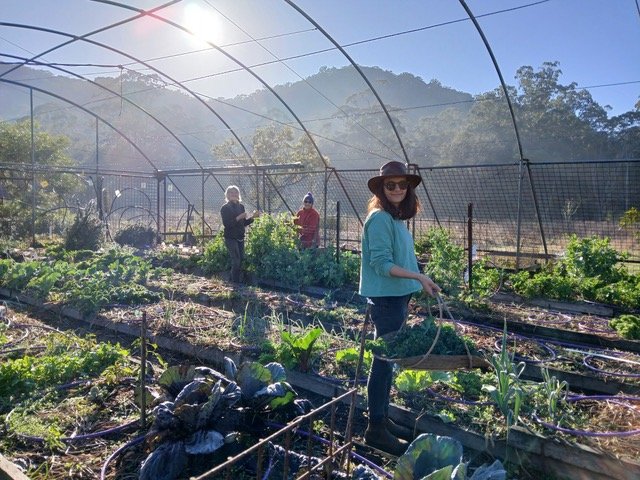
Early days of food production. Image courtesy of Narara Ecovillage.
Narara
A thousand kilometres south of Maleny on the NSW Central Coast, Narara Ecovillage is another intentional community where eco-design meets intergenerational living, offering a blueprint for another way of life.
Started by gathering like-minded people in the naughties, the land was co-purchased in 2012. There are now 200 Nararians, with 58 homes completed, and more in the planning stage.
Narara has permaculture gardens, solar panels glinting on rooftops, a smart grid and battery, and a rhythm of cooperation that embodies climate action and empathy synthesised through the ritual of everyday life.
Founder Lyndall Parris reflected on Narara’s evolution, explaining that “daily, I experience the joy of living here. Two of our adult children, their partners, and grandkids all live in the ecovillage too. It’s a wonderful childhood — riding bikes, climbing trees, playing music, planting seeds, growing produce, and very easy playdates. It’s the childhood I wish I had!”
Nestled beside Strickland State Forest and only a hop, skip, and jump to the ocean, Narara’s roadmap sets clear goals to 2030: increase biodiversity by 2% every four years, grow 15,000 kilograms of food annually, and decarbonise by 75%.
At its heart, Narara Ecovillage aims to draw on indigenous wisdom, live within the planet’s ecological limits, and grow an inclusive, resilient, and connected community — a contemporary village with ancient roots.
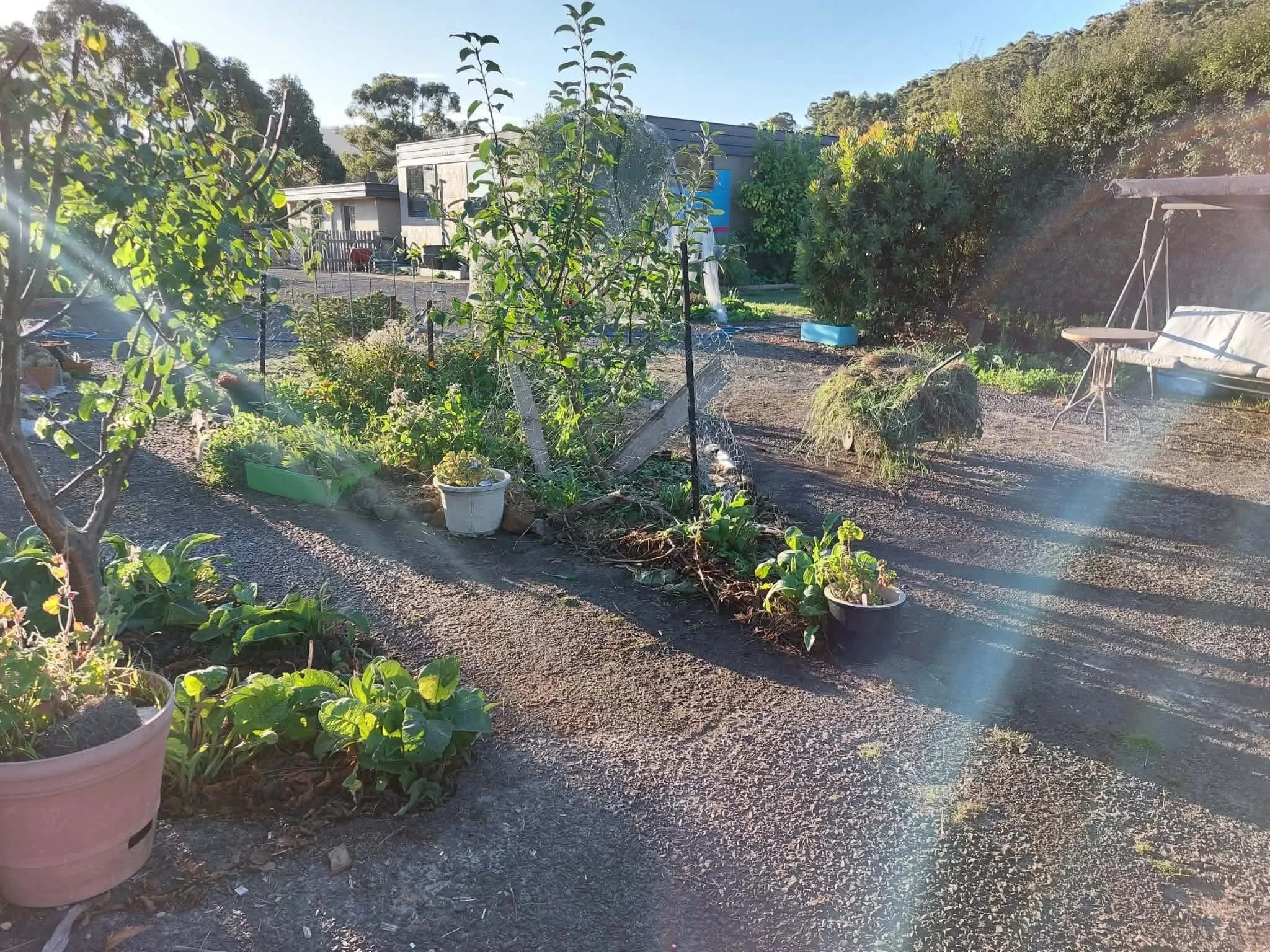
Tasman Ecovillage was built in 2011 on the site of a former motel and golf course. Image courtesy of Tasman Ecovillage.
Tasman
Near the southern tip of Tasmania/Lutruwita, in the small coastal town of Nubeena, Tasman Ecovillage took root in 2011 on the site of a former motel and golf course.
In this breathtakingly beautiful, windswept, and flood-prone corner of the Universe, sustainability isn’t theoretical — it’s a daily practice of cooperation, regeneration, and community in action. Today, 45 residents live on a patchwork of repurposed dwellings, shared permaculture gardens, solar infrastructure, and bushland.
Founding resident Karen Weldrick didn’t sugarcoat her 14 years of village living. “The vision hasn’t always matched the reality, and our EV [ecovillage] today bears little resemblance to the key pillars of the founding members, but many things about this place make it greener and more sustainable than life in the ‘burbs. “We now have bushland providing wildlife corridors right in the middle of the village, which is something I’m really proud of.”
Weldrick — who lives in a converted two-bedroom motel apartment — explained Tasman’s inclusive membership model supports housing affordability, drawing in diverse residents from young families priced out of urban centres to low-income retirees seeking more purpose and connection in their twilight years.
“People have managed to build small 50 sqm homes and are getting housing security they never would have had otherwise.”
The seeds of change planted by Findhorn have taken root globally, forming a complex network of intentional communities redefining how humans can live within ecological limits.
And in Australia, villages including Maleny, Narara, and Tasman explore how cooperation can lead us toward a more ecologically harmonious connection to Country.
While mutual respect of nature and communal living are a common thread, each ecovillage is a unique snowflake — reimagining the model for inclusive, community-based coexistence, shaped by its bioregion, culture, and climate.
Whether you’re looking to lighten the weight of your carbon footprint, regenerate land, or rediscover the connectivity of communal living, one of the 10,000 ecovillages dotted around the globe might just hold the tree (or sea) change you’ve been waiting for.